Saint Thirugnanasambandar, the child prodigy and the boy saint who is one among the Naalvars (the four great Saivite saints) is considered as an avatar of Lord Murugan by learned scholars. Thirugnanasambandar has performed many miracles, but the one associated with Thirumarugal touches the heart in a deeply human way.
Thirumarugal is a quiet, unassuming village, just a little beyond Thiruchengaatankudi which we had just visited. It houses a powerful Shiva temple dedicated to Rathnagireeswarar, also known as Manikkavannar. The very name Thirumarugal comes from its sthala vriksham, the sacred banana tree. Like all ancient temples, this one too is defined by its holy tree—but here lies the wonder: banana saplings taken from within the temple premises refuse to grow elsewhere. They flourish only within the divine presence of Rathnagireeswarar, as though bound by an unseen spiritual vow.
But beyond this botanical marvel lies a story that truly moved me.
Long ago, a merchant lived in Thirumarugal with his seven daughters. He had promised his sister that one of his daughters would be married to her son—a practice common among close kin. Yet each time a wealthier suitor appeared, temptation overruled his word. One by one, six daughters were married off, the merchant seemingly unmindful of his promise.
The young girl, moved by compassion for the man who had waited patiently for years, and fearful of her father’s anger if she expressed her desire to marry the man in waiting, eloped with him. That night, they sought refuge near the Thirumarugal temple, hoping to marry the next day. Fate, however, had other plans. The groom was bitten by a poisonous snake and died instantly.
The girl’s grief poured out as an oppari, a lament so raw and piercing that it moved all who heard it.
The cries reached the ears of Saint Thirugnanasambandar, then only seven years old. He was visiting Thirumarugal at the time, moving from one Shiva temple to another—mostly by foot, or carried by others in a palanquin, accompanied by his followers. Drawn to the spot, he listened quietly and felt that Lord Shiva could not remain indifferent to the suffering of a devotee. Standing there, the child saint sang the Thevaram “Sadaiya enum maal,” pleading with Shiva to show compassion. As he completed the eleven verses, a miracle occurred—the dead man opened his eyes, as though waking from a deep sleep. The crowd erupted in chants of “Om Namah Shivaya,” prostrating before the boy saint, awestruck by Shiva’s grace flowing through him.
Recalling this story, I felt a deep sense of alignment—I was standing in Thirumarugal itself. The moment felt even more special, knowing that my guruji, Shyamala mami, had taught me two Thevarams sung here.
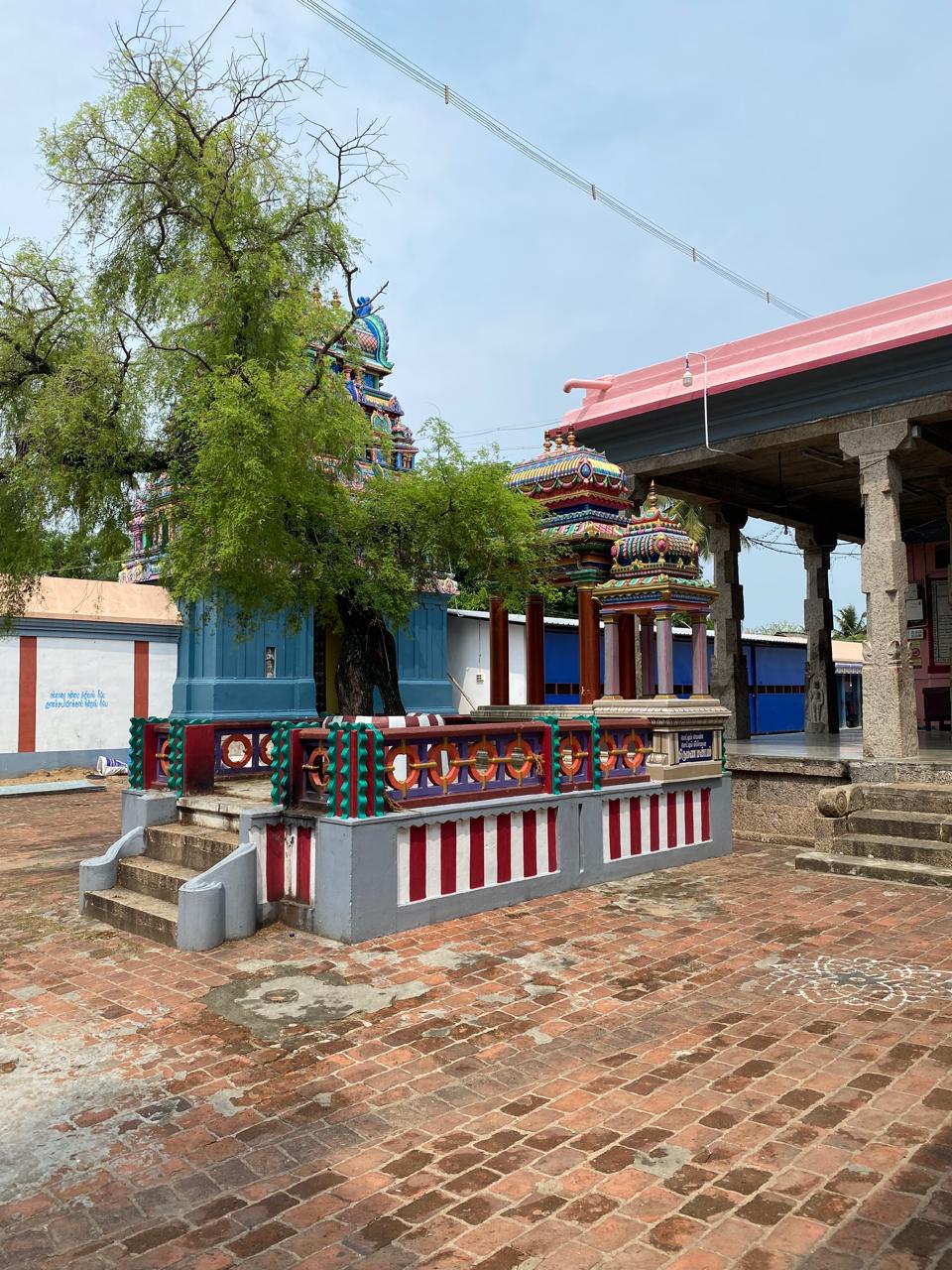
The place where the couple were married off has a nicely made mandapam. The temple had witnessed a kumbabishekam recently and was all shiny in its renewed glory.

The temple lies close to Thiruchengattankudi, and both Appar and Thirugnanasambandar have sung Thevarams here. After this miracle, Sambandar stayed on at Thirumarugal for some time and was joined by Siruthonda Nayanar from nearby Thiruchengattankudi. Sambandar sang a Thevaram that beautifully describes both sacred kshetrams:
Angamum VEdhamum Odhum Naavar…
(The verse linking Thirumarugal and Thiruchengattankudi in divine poetry.)
The temple has many unique features. Rathnagireeswarar, facing east, and Vanduvaar Kuzhali Amman, with a rare south-facing sannidhi, preside here. The temple is a Maada Koil, built on an elevated platform by Kochenga Chozhan, who deliberately designed such temples to prevent elephants from entering.
The Shiva lingam here is swayambhu—self-manifested. Legend says it was discovered by King Kusakethu, who unknowingly struck the lingam while tilling the land—marks that are said to remain visible on the lingamurthy even today. During his reign, a severe famine struck the region. Stricken by despair and guilt at being unable to save his people, the king resolved to end his life. At that moment, Lord Shiva appeared before him, accompanied by the Shiva ganas, moved by the king’s steadfast devotion. The land then witnessed a miraculous rain of precious stones—rubies and emeralds—earning the Lord the name Rathnagireeswarar, the Lord of the Jewel Hill. This divine grace transformed the fate of the village, turning it into a prosperous one.
Another beautiful legend connects this temple to Mahalakshmi. During a debate among the sages on whom to honour among the Trimurtis, Sage Bhrigu visited Vaikuntha. Lord Vishnu, lost in yoga, failed to notice him. Angered, Bhrigu kicked Vishnu on the chest—but Vishnu, ever compassionate, instead massaged the sage’s feet, for the act of kicking would have hurt them.
Lakshmi, distressed by this act—especially since she resided in Vishnu’s heart—left Vaikuntha and descended to Bhoologam/Earth. She reached Thirumarugal, created a pond on the eastern side of the temple, and worshipped Manikkavannar.
In the month of Aavani, (July/August) on a Friday when it was Pournami/Full moon, Vishnu came down to reunite with Lakshmi. Shiva joined them, and this divine reconciliation is believed to have given rise to Varalakshmi Nombu. The pond she created is known as Mahalakshmi Theertham. Because of this, Thirumarugal is believed to reunite estranged couples and bless harmonious marriages.
It is also said that since Thirugnanasambandar revived a man who died of snakebite, those suffering from fear of poison, reptiles, or snake-related afflictions can worship here for relief. Even households troubled by recurring snake sightings seek the Lord’s grace here.
When we visited, a young couple was performing abhishekam for the Lord and the Goddess, offering thanks for the happy marriage they had prayed for here. They shared their prasadam with us and lovingly offered thamboolam with bangles to my mother and me. The young woman repeatedly asked my mother to bless her, believing it to be a good omen to receive blessings from an elderly woman who, in her eyes, had lived well and fulfilled all her worldly duties.


As we walked around the pradhakshina path, we visited the Joram Theertha Vinayagar sannidhi. This Vinayagar had cured the Chozha King’s fever. Unfortunately, my phone’s display suddenly died, depriving me of many photographs. Thankfully, it was repaired at a small shop in Karaikal—much to my relief.
After all, these days, we may manage without food for a while… but never without a phone.
This is a place that does not see crowds on ordinary days. The temple is calm and unhurried, wrapped in silence. Only a few locals sat outside the office, chatting about some local incident. One of them, realizing that we were newcomers, handed us pamphlets about the upcoming festival, seeking donors.
The locals, as well as devotees who come from far-off places, must help in whatever way possible to maintain and uphold these treasures of our past. Darshan here comes without long queues or noise—just you and the Lord, face to face. Peace. Blessed.
If you have missed reading about my visit to Thiruchengattankudi, click here.
Hey Megu, as always for me it was like I was there with you walking the talk. Adding on to my knowledge of temples not heard of hitherto. Many Thanks.
Thank meghu for the free visit to rathinagireeshwar temple.
Awesome ,you took us on a virtual trip to this temple.
thank you
Your first hand narration of Temple experiences are unique and original . This cohort of readers would relish a dedicated channel for fresh content . After all , not everyone is fortunate enough to experience this in person !
As always an absolute pleasure and delight reading about the significance of this temple and the history behind it. Thanks to you, I am learning more about our culture, one temple at a time. Keep them coming!
Very nicely elucidated!! Made very interesting by the simple yet classy style of writing! Looking forward to more 😍
It’s very nice to follow the story of the temple thank you
Article featuring four stories made good reading. Silent temple speaks a lot about the past miracles and the power of surrender to the higher power. Keep journeying and journaling!
Megu I really wonder how you are looking temples, from what angle and the depth of it. Going to temple pray and listen to sthala puranam was my vision of temples. But after reading your articles and stories, my approach to temples have completely changed. Thanks to you.
Fascinating read Megu! A great reminder of history, culture embedded in these sacred sites.never knew temples could be seen as lessons in history as much as spiritual centres. The miracles of Thirugnanasambandar, lord Rathnagireeswarar’s tranformation of a famine hit village to a prosperous one, divine significance of Varalakshmi nombu. I especially resonate with the feeling of finding peace and positive energy in our temples.keep your spiritual journey going Megu and walk us thru these silent yet powerful temples.your incredible writing style makes these experiences so magical.