
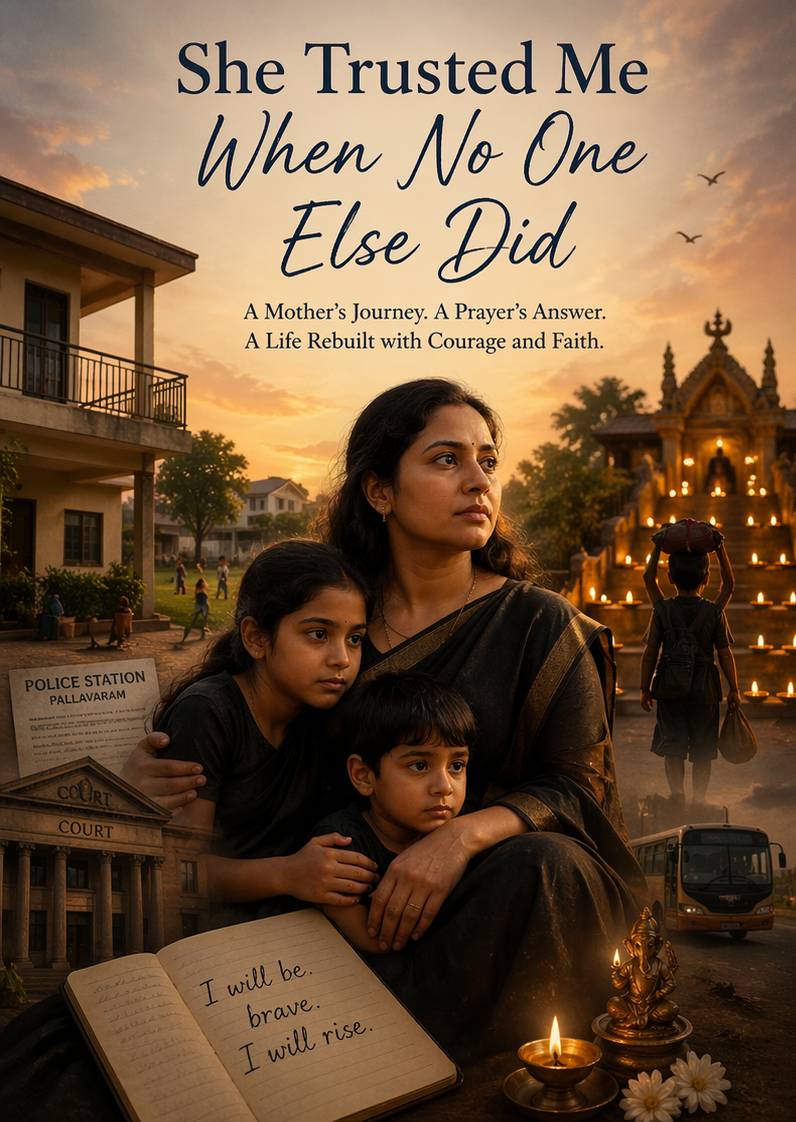
I will take the house,” I said, trying to keep my voice steady as I looked at the broker.
He had already spoken at length about Pallavaram—how it was an upcoming suburb, how families preferred it, how safe it was, how convenient it would be with St. Mary’s School nearby, and the bus stop and railway station within easy reach. His words had washed over me earlier, but now they returned, settling into place with reassurance. Safe. A school nearby. Not expensive. For now, that was enough.
Vatsan had already claimed the house as his own. My six-year-old was darting from one room to another, his laughter echoing against the bare walls, his small feet making the emptiness feel alive. In a moment, he had climbed onto the railings of the front balcony, peering out as though he had always belonged here.
“Vatsan! Get down!” Geetha’s voice was firm, carrying a seriousness beyond her years. At ten, she had already begun to understand more than I wished she did. She hurried toward him, gently but firmly pulling him away from the railing, her eyes briefly meeting mine—as if to reassure me that she would help, that she was there.
I felt something tighten in my chest… a quiet ache mixed with gratitude.
This house was small. Empty. Bare. But it was ours—at least, it would be.
For the first time in a long while, the thought didn’t frighten me.
I had finally reached a point where I could say to myself—enough is enough.
I had just walked away from my marriage, stepping into an unknown life with my two children, ten and six, holding on to me, trusting me. I had no job. No support from my parents—they were already burdened, indebted to my brother Rajagopal. Yet here I was, with responsibilities that did not wait—school fees, rent, food, their future… everything rested on me.
The fear came back! It would rise suddenly, tightening its grip, making me wonder if I had done the right thing. But somewhere, beneath that fear, there was something stronger. A quiet, steady voice that refused to be silenced. Perhaps it was freedom—freedom from the harshness I had endured for years, from the suffocating hold of my in-laws, from a husband who had long stopped being a partner.
I had tried—oh, how I had tried—to make the marriage work. I had bent, adjusted, endured, holding on to the hope that things would change. But some battles do not heal you; they only drain you.
At the core of it all, our values simply did not align. And I could not imagine myself—or my children—growing up in an atmosphere so devoid of the values I held dear.
I drew in a long breath. It steadied me. Slowly, the panic began to fade, and in its place came a sense of resolve. I couldn’t afford to fall apart—not now.
My mind began to organise itself, one step at a time.
First, I had to sell another piece of jewellery. Amma had everything locked away. Going to her and asking for it felt humiliating. I hated that feeling—standing there, asking for what was mine, and still feeling small. But I needed the money.
Then came the children. I had to get them admitted to St. Mary’s School. It wasn’t what I had once dreamed for them. Not even close. But it was nearby. They could walk. No transport, no extra expense.
This is what it had come to—counting every rupee, cutting every corner, choosing only what I could afford to survive.
This was not the life I had imagined. But this was the life I had chosen.
“Pillayaar appa, please make it work”
Only when Geetha hugged me, I realized that I had uttered that line aloud.
……………………………………………………………………………………………………………………………..
“Uthra, Uthra… look what your son is doing!” my mother’s voice rang out, sharp with irritation.
I paused in the bedroom, a stack of freshly folded clothes in my hands. I had been arranging them neatly on the open shelf—there were no built-in cupboards in this house. I glanced around for a moment. The house was simple, almost bare, but the front balcony made up for it. It overlooked a small park, and in the evenings, it came alive with the shrieks and laughter of children at play. That sound… it uplifted my spirits.
Another loud splash broke my thoughts.
I hurried toward the bathroom, the sound of water growing louder with each step. When I reached the doorway, I froze for a second.
Vatsan.
He was standing in the middle of the bathroom, gleefully scooping up water with a mug and pouring it all over the floor. Water we had carefully stored in buckets—for two days—was spreading across the tiles. His shirt was already soaked, clinging to him, and he had just begun to recover from a cold.
“Amma, I am cleaning the bathroom for you,” he said, looking up at me with complete innocence, his eyes bright with pride.
My heart softened for a brief moment… and then tightened again.
“Vatsan, this water is for two days,” I said, trying to keep my voice calm but firm. “Stop wasting the water this minute and come out of the bathroom right now!”
Behind me, I heard my mother mutter, almost to herself but loud enough for me to hear, “A boy growing up without a father will behave like this only.”
I turned and looked at her. She was sitting in the living room talking to someone on the phone. For a second, irritation rose in me—but just as quickly, it faded.
At 50 she seemed worn out but her face still strikingly beautiful. The worry lines had deepened, making her look older than her years.
Poor Amma. Beneath all her worry for our future lay a deeper fear—that I, along with my children, might one day become a burden on them… and on my brother, who never parted with money for anyone beyond his own family, not even for our parents.
That fear shaped the way she treated us. It came through in sharp words at times, in sudden sarcasm, in a certain harshness that lingered when we were around. She didn’t want the neighbours to know I was divorced. Instead, she told them my husband was working in Dubai—even when I gently urged her to tell the truth. She was worried of how the world would see us, of what people would say.
Our poverty did not just limit what we could afford—it slowly crept into Vatsan’s world and shaped how he saw himself. He began to notice the difference, the way people treated us because we couldn’t afford so many things. What he couldn’t understand, he carried as anger. What he couldn’t ask for, he turned into defiance. Each quiet denial, each unspoken humiliation, found its way into his behaviour—making him more restless, more reactive with each passing day.
Geetha, with her maturity, seemed to take it in stride. Our difficulties did not affect her the same way. But for Vatsan, it was different. The weight of our circumstances, combined with Amma’s constant undertone of resentment, began to affect him deeply. He grew restless… then aggressive… at times almost unmanageable.
I watched this change with growing fear. More than anything else, I was worried about him—about what this would do to him as he grew, and whether I would know how to guide him through it.
I turned back to Vatsan and gently pulled off his wet shirt. His small body shivered slightly, and I reached for a towel, rubbing him dry.
As I worked, my thoughts wandered.
Maybe he misses his father… maybe that’s why he is so restless, so difficult. Geetha understands things in a way no ten-year-old should have to. She adjusts, she observes, she helps.
But Vatsan…
I heard the calling bell, and before I could even move, Vatsan had already dashed to the door.
“Mama! Look, I want to show you something. Come here!” he shouted, his voice bubbling with excitement.
“Wait da, Vatsan,” my brother said, stepping in with a smile. “I have a surprise for you. Guess what…”
Vatsan’s eyes widened. “I know, mama… we are going to eat butterscotch ice cream!”
I couldn’t help but smile faintly from where I stood.
“Vatsan, we are going to Sabari Malai,” my brother said gently. “I am taking you with me. But listen… you will have to follow some strict rules for 48 days. Only then we can go. Okay?”
“Yes, mama!” Vatsan didn’t hesitate for even a second. He began prancing up and down the small living room, his excitement filling every corner of the house.
He didn’t know where Sabari Malai was. He didn’t know what the rules meant. But that didn’t matter. He was ready.
I watched him quietly, something stirring inside me.
With the little money I had earned from selling saris, I bought him 3 sets of black shirt and black veshti. These days, I had started picking up small jobs, little bits of business—anything that didn’t pull me away too much from home, but still brought in some income. Every rupee mattered. Appa’s pension, though small, helped us manage the groceries.
But what happened over the next 48 days… I had not expected.
Vatsan changed.
He woke up early, bathed in cold water without complaint, wore his sandhanam carefully on his forehead, and sat quietly on the kitchen floor, waiting for his food on a freshly washed banana leaf. The same boy who would run wild in the house now sat with a calmness and responsibility beyond his years.
The rules were strict—only freshly cooked food for those observing the vratham. While the rest of us ate leftover rice soaked in salted water, Vatsan would eat idli and chutney, his face glowing with contentment. But more than the food, I think it was the importance he felt… the attention, the sense of purpose.
His restlessness faded. In its place came a quiet discipline, a surprising maturity. My heart was filled with pride.
“Iyyappa… this is all because of you,” I would whisper in my prayers, more often than I realised. “Vatsan is becoming so easy to manage. Thank you…”
I had always prayed to my Ishta Deivam, Pillayar. But now, my prayers found their way to Iyyappa too—especially when I looked at my little boy. His forehead lined with sandhanam, dressed in black, carrying himself with such sincerity… he looked older, steadier.
The day of the Irumudi pooja arrived.
It was held in our apartment, and my brother Rajagopal had taken care of all the expenses. Devotees who were preparing for the pilgrimage had gathered. The Guruswamy was making all the preliminary arrangements for the pooja. Eventually, the house was filled with the sound of bhajans, voices rising and falling in devotion.
As the pooja progressed, the 18 steps were lit up, one by one, glowing softly in the dimming light. When it was time for the final aarathi, I was asked to draw the curtains and switch off the lights.
The room fell into darkness.
Only the lamps on the 18 steps remained, flickeringbeautifully. The ambience especially in that lighting seemed surreal.
The bhajans rose to a crescendo.
And in that moment the room pierced with the shrill sound of the phone.
I hurried to answer the call, lest it disturb the pooja proceedings.
“Is this Uthra?” a male voice asked.
“Yes, this is Uthra. Whom do you want to speak to?” I replied, a trace of unease creeping in. The house was full, voices rising in prayer — who could be calling at such a time?
“I am calling from Pallavaram Police Station,” he said. “An arrest warrant is being sent to your house.”
For a moment, everything went still.
I was shell-shocked. Speechless. But inside, my mind raced wildly.
Why? Why me? What have I done?
How could I tell anyone? In a few minutes, Vatsan and Rajagopal would be leaving for Sabari Malai. I couldn’t let this shadow fall on them.
I decided to remain silent.
I waited until the van carrying the devotees pulled away.
Only then did the fear rise fully within me.
What am I going to do? What if the police walk in now? What will the landlord think? What if he throws us out?
And beneath it all, a quiet certainty formed — this must be connected to my former husband, Venkatarathinam.
Suddenly, I thought of Seshagopal — my cousin from my maternal side. Sesha had stood by me through my divorce, even helping pack my belongings from my in-laws’ house when I couldn’t bring myself to step inside.
I called him immediately.
“Sesha, I am in trouble. I need your help…”
“Uthra, what happened? Is the irumudi pooja over? I thought you’d be busy today.”
I told him everything.
Without hesitation, Sesha said, “I’ll connect you with a friend of mine — he’s an advocate.”
Through him, we reached the Pallavaram Police Station. The truth emerged: there was no arrest warrant. They wanted me for an enquiry — something related to sales tax evasion and pending dues. The case fell under Salem jurisdiction, and I would have to appear in court there.
“Sesha, thank you… I don’t know what I would have done,” I said.
“Uthra,” he replied gently, “I hope this gets resolved soon. Just when you were beginning to settle down with the children…”
“It must be my stars,” I said with a faint smile he could not see. “This too shall pass. I will be brave.”
That evening, Amma noticed me taking the silver lamp she had bought for my wedding.
Her reaction was immediate.
“There goes another silver lamp from the house! You have brought yourself, your children — and all your problems — into this home. What will people say if they hear about this court case?”
“Amma,” I said quietly, “only if you tell them will they know. I will handle this. You take care of Geetha. Vatsan will be back only after a week. I am leaving for Salem tomorrow.”
But she was not done.
“All your jewels and silver vessels were bought with your father’s hard-earned money. And now you are selling them one by one! Will your troubles never end, Uthra? Why must I alone suffer like this, when everyone else’s children live peacefully?”
I did not respond.
Instead, I called an old friend — Madhavi Sadagopan in Salem. Years ago, we had lived in the same apartment when I worked in a saree weaving unit there. She now worked at a bank. A warm, dependable person.
As the phone rang, I whispered a prayer.
Pillayar appa… please let her answer.
She did.
And not only that — she insisted I stay with her.
The silver lamp I had taken helped cover the train tickets — mine and the advocate’s — and his hotel stay.
The next day, at the Salem court, I came face to face with my past.
But he was not there.
Venkatrathinam was nowhere to be seen.
Instead, I found his five partners — anxious, frustrated, and clearly under pressure. It soon became evident that they, too, were searching for him.
They had started an FMCG business together. And somewhere along the way, he had used my name in place of his.
They had failed to pay the sales tax. Now, penalties and dues had been imposed — two lakhs per partner.
And I had been pulled into it.
My head reeled.
Even they seemed helpless.
“We have been trying to locate him,” one of them said. “He has not been responding. We don’t know where he is. He only gave your Pallavaram address before he went into hiding ”
I stood there, absorbing the full weight of it.
Not only had he walked out of my life…
he had left behind a shadow that continued to follow me.
I pleaded with them, my voice trembling despite my effort to stay composed.
“I am divorced now. I have no connection with any of this. Please… I should not be held responsible.”
They listened. They understood my situation.
But they could do nothing.
And for the first time, I felt the stark loneliness of it all —
to be held accountable for something I neither knew of nor had any part in…
and to stand there, alone, while the person responsible was missing.
For the next hearing, a week later, Madhavi found me a free bus ticket from Chennai to Salem. I accepted it gratefully and bought a ticket only for the advocate.
As we entered the court, the advocate, Sivakumar—perhaps in his late thirties—tried to hold my hand. I moved away immediately and walked ahead, a familiar dread rising within me.
Will my troubles never end?
As expected, he persisted.
“Have dinner with me at the hotel,” he said. “There are empty rooms… you can stay the night.”
“Thank you, sir. But no,” I replied, firmly enough to end it.
The second hearing concluded without progress.
For the third hearing, I told Sesha, “I don’t need an advocate. I will argue the case myself.”
He nodded. No questions. I was grateful for that.
Why do single women face such advances?
It wasn’t my appearance—my saris were old and worn. I wasn’t outgoing, nor did I encourage conversation. Yet there seemed to be an assumption—that a woman alone must somehow be available.
The thought unsettled me.
At Madhavi’s house, she handed me a sari.
“Wear this. I think the blouse will fit you too.”
I was touched. I had only three decent saris, and she knew I would never ask.
Amid so many struggles, God was quietly showing me where goodness lived.
Before leaving, I prayed.
Pillayar appa… today, please let this end. I cannot go on like this. Let there be a miracle. Let me not return for another hearing.
I felt lighter afterwards—perhaps steadied by both prayer and Madhavi’s quiet strength.
In court, I told the judge I could not afford an advocate and would represent myself. I asked for time to pay the two lakhs. Time was granted.
Outside, I approached the other partners and explained my situation.
They listened.
Then one of them said,
“It’s not your fault. You don’t have to pay two lakhs. We will manage that. Just give Rs 20,000.”
From two lakhs… to twenty thousand.
Is this your doing, Lord?
I knew it was. My prayers had not gone unanswered.
Relief came swiftly—followed just as quickly by another question.
Where will I find Rs 20,000?
The scene that morning at home flashed in my mind.
Amma was complaining, as usual.
“Even Rajagopal says Uthra keeps bringing new problems into the house!”
Appa sat silent on the sofa—never complaining, but never offering solutions either.
Only Geetha had come to me before I left. She hugged me and said,
“Amma, don’t worry. This will get solved. I’ll take care of Vatsan. He’s much better after Sabari Malai. Don’t mind Paati… she’s always like that.”
Her words lingered.
Back at Madhavi’s house, I shared everything, wondering if she could help me arrange a loan.
She listened quietly, then walked to her cupboard and returned with a bag.
It was filled with her jewels.
“Pledge these and get the money,” she said. “Return them when you can. I’m giving this without my family’s knowledge… I don’t know how they will react.”
I was speechless.
What had I done to deserve such trust?
While my own family struggled to support me, here was someone—just more than an acquaintance—placing her faith in me without hesitation.
“Thank you,” I whispered, my hands folded.
“Get a good job,” she said gently. “You can recover them easily. I trust you.”
It took me a year to return her jewels.
When I did, her words cut deep.
“Uthra, thank you for returning them. But… let’s not stay in touch. My family is not comfortable with me associating with you.”
It felt like a knife to the heart.
And yet, I understood.
Her family saw me differently. Perhaps they thought I had taken advantage of her. Perhaps they wanted to protect her.
I held no bitterness.
Only gratitude.
For in my darkest moment, when I had nowhere to turn, she had been the answer to my prayer.
And for that… I will remain forever thankful.
Nice middle class family story.Well written with easy free flowing language. Expecting another story from your desk
Very touching story. Your narration makes us feel Uthra’s pain and helplessness. Well written Meku. Makes one wait eagerly for its sequel. 💐🙏🏽
There is no sequel thought of yet. Just started writing this in tamil neethi.
Will her problems never end.. this is the case with numerous women across the society we live in… I take pride in the fact that with all the dark waters flowing under them, many many women are carrying themselves with dignity and fortitude. Thanks for the write up Megu. Reminds me time and again never to disregard the feelings people around us.
Hope there are several Madhavis to uplift the Uthras of the world Usha
God give more strength to all Uthras out there!!
After reading this, it took sometime to collect myself.
Very touching story Megu!
Emotions very well expressed in your writing! Well done!!
Go on dear!
Thnx Malli. This story will be continued.
Very gripping narrative of a struggling single mom of two & as mothers we are able to relate to the struggles Uthra undergoes.
There are millions of women quietly suffering in unhappy & abusive marriages in India.
One of the most powerful stories from you, Megha! The emotions and the struggles come through so vividly with your writing. You have skillfully captured so many social issues faced by women, especially single women, in our society. Well done! Looking forward to the next story.
Excellent story and the way you wrote. Different types of people and middle class problems beautifully narrated.
Well done Megalai.It depicts the struggles faced by middle class women.
Well written..can imagine and understand the hardships faced by middle class divorced women…True only God can support
Beautifully written. Touched multitude of issues; Faith, patience, self respect, family dynamics, divorce, single parent, freedom. Well written as usual and your writing was engaging m. Well done e Megu.
Can imagine divorced middle class single mom’s hardships…very well written
Nice story!! True remaining positive helps in every situation!!
Somehow this short story leaves us in a limbo feeling
Very nice , a lot of empathy in it , perhaps you can bring out Part 2 and try to vindicate her and make her rise
Well written
Truely life is a struggle for some
The degree os struggles is different for all
U wonder why?
Why the tunnel is so long and dark ? When would one see the light on the other side!
In the process one just keep jumping one hurdle after the other
Single mom life is never easy esp when it’s a struggle to bring children up without support and money money it is in a poor man’s world
Salute to all the women like her who brave the storm and move on with their lives
The story touched my Heart. The emotions so well expressed through your words meghu
Very nice and brings tears to read Uthra’s struggle
The way you penned is merely like we are seeing the scene I don’t know how to describe
Sooooo nice Mehu 👌🏻👏🏻👏🏻
Your story reminds me of Kannadasan’s famous lines :
“வாழ்க்கை என்றால் ஆயிரம் இருக்கும்,
வாசல்தோறும் வேதனை இருக்கும்,
வந்த துன்பம் எதுவென்றாலும்,
வாடி நின்றால் ஓடுவது இல்லை,
எதையும் தாங்கும் இதயம் இருந்தால்,
இறுதி வரைக்கும் அமைதி இருக்கும்.
Good story line and very realistic Megha! Great narration. You could make one on why this type of life for her. Husband or Parents (mother) that would be interesting.
An excellent story that touched my heart. .. To lose a dear friend for no fault, was the most poignant part, at the end ! Your stories always have an unexpected twist ! Loved reading it for its simplicity,
A deeply moving story of a mother’s resilience, faith, and silent courage. Uthra’s journey reminds us that even in the darkest phases, kindness, friendship, and unwavering belief in God can rebuild a shattered life. The theme beautifully highlights sacrifice, motherhood, and the power of standing strong against adversity. Madhavi’s support and Uthra’s gratitude add so much emotional depth. Truly inspiring and heartfelt. ❤️🙏