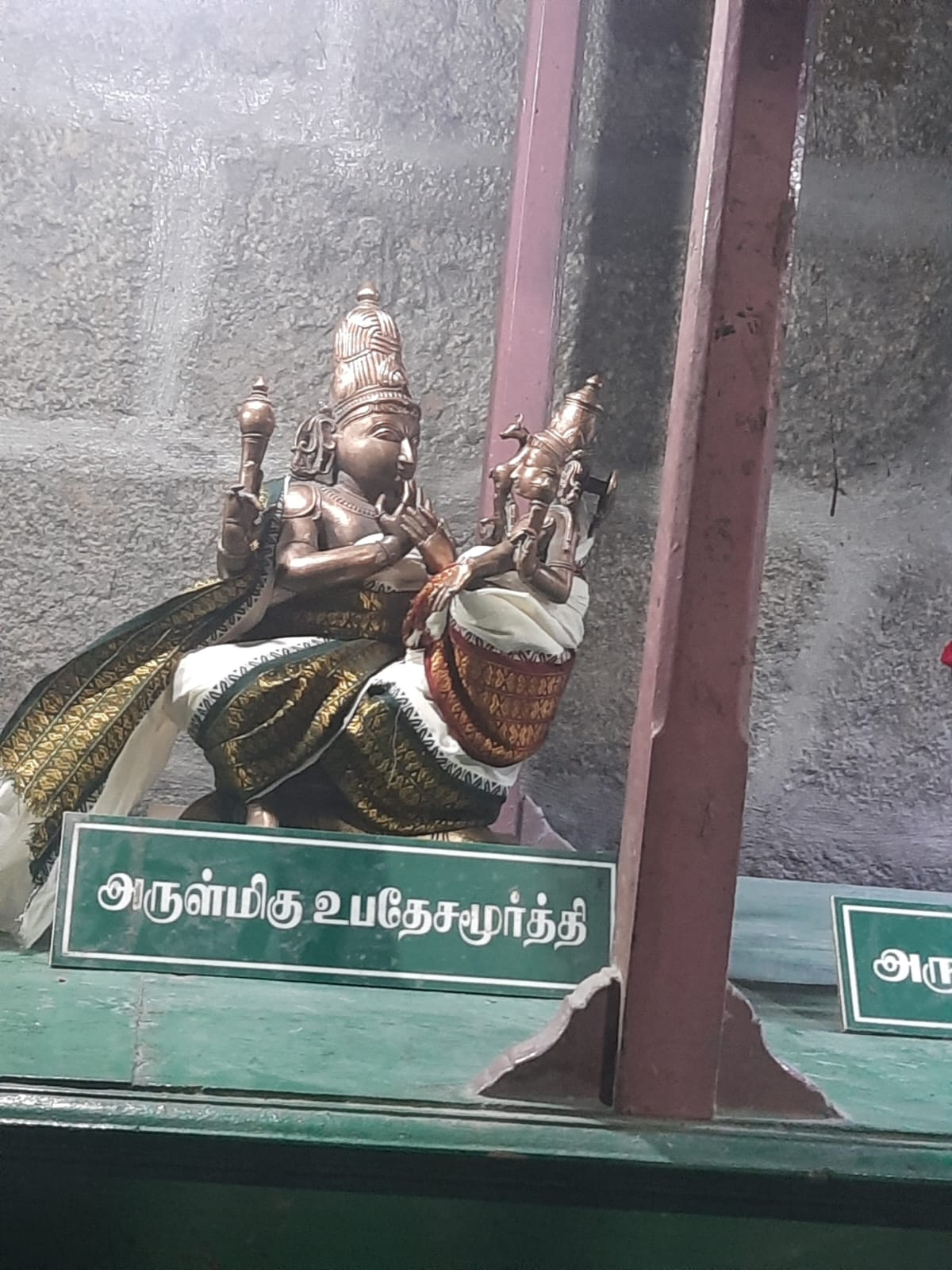
At Thiruporur Murugan Temple, (our Kula deivam koil) a quick walk around the praharam of the main sanctum reveals a treasure that many devotees might easily overlook. Among the beautifully arranged utsava murthis stands a bronze, Upadesa Murthy, where Lord Muruga is seated on the lap of Lord Shiva, imparting the profound meaning of the sacred Pranava Manthiram, “Om.”
This striking murthy finds its roots in beautiful episode from the Kanda Puranam.
Once, Lord Brahma, the creator, passed by young Muruga without offering due respect. Angered by this arrogance, Muruga stopped him and asked him to introduce himself. Brahma proudly declared that he was the creator of all beings and the guardian of the four Vedas. Muruga then posed a simple question. If you are indeed the guardian of the Vedas, tell me the meaning of the Pranava Mandhiram.
Brahma’s dismissive reply, that he, Brahma himself is the embodiment of Om, revealed the creator’s ignorance. Recognizing this, Muruga imprisoned him. With Brahma confined, creation itself came to a standstill, and Muruga assumed the role of creator.
This unique form of Muruga, the Brahma sastha, holding the kamandalam and akshamalai, symbolizing his role as Brahma, can be seen at Shenbakeswarar temple at Natham Parameswaramangalam Temple, (near Kalpakkam, Off ECR) a rare depiction
Concerned by the halt in creation, the devas and sages turned to Shiva for help. Shiva first approached Muruga gently, attempting to persuade him to release Brahma. When that failed, he commanded him with authority. But Muruga stood firm. How could Brahma be released when he did not understand the very essence of the Pranava?
It was then that Shiva, filled not with anger but with admiration for his son’s wisdom, requested Muruga to teach him the true meaning of Om. Reversing conventional roles, Shiva seated Muruga on his lap, bowed his head, and listened in reverence, his hand covering his mouth, signifying humility before knowledge.
This story is captured in the iconic Upadesa Murthy bronze at Thiruporur. Not sure whether Swamimalai where this incident happens has this type of bronze. The priest who showed us said, its unique to Thiruporur and Swami Malai does not have it.
This legend and iconography reminds us that wisdom is not bound by age or hierarchy. A guru can be younger than the disciple. A father can learn from his son. True knowledge flows where there is humility to receive it.
Megu,this is a wonderful find.while Swamimalai is celebrated as the sacred place where Murugan became Swaminatha, the guru who revealed pranava to Shiva—-your update on this unique bronze form at Thiruporur is deeply moving.The way this rare iconography is explained not only informs the mind but also touches the soul, reminding us of lord Muruga as the eternal guru, the embodiment of divine wisdom.In every kshetra, he reveals a different aspect- here the SILENT TEACHER.
This is a favourite story that most of us grew up listening to. Thank you for refreshing those memories. In the corporate world today, we have programmes encouraging seniors to learn from their juniors. It’s remarkable that our puranas are way ahead of the times.
Very true. Prof Madhusudanan Kalaiselvan…. I have done courses on Saivism and he is young enough to be my son. Age truly does not matter.
Excellent Madam. Murthy is very cute and Amazing 👌👌👌
What a wonderful story ! Though I was already familiar with it, this narration brings out the full background so beautifully and vividly. At the earliest opportunity, I look forward to visiting the Kandasamy Kovil to have the darshan of this உபதேச மூர்த்தி. Thank you, Megalai ji, for sharing such an enriching piece of information 🙏🙏🙏