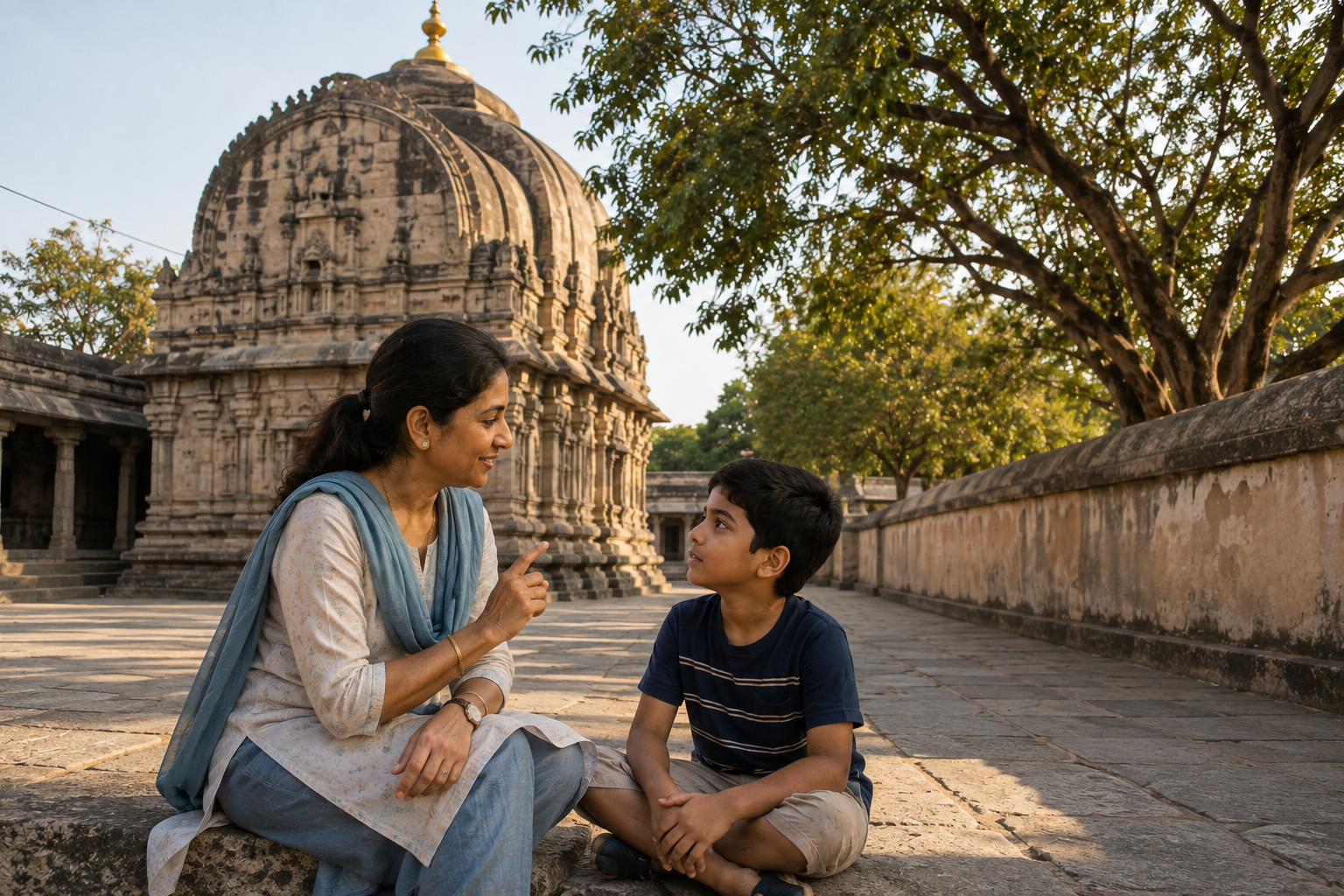
“Paati, I thought we were going to the Pillayar temple nearby… You just drove past it. Which temple are we going to?” asked Akshit.
“I am taking you to the Padi temple. It’s only a few kilometres from our house. I thought you would love this temple,” replied Padma.
“New one?”
“Nope. It’s ancient! Remember the saint Thirugnanasambandar? He has visited this temple and sung songs here. I want you to walk on the same soil that the great saint Thirugnanasambandar once walked on.”
Padma always made sure that Akshit was well informed about Hindu culture and heritage.
After finding a parking spot, they walked into the temple. It was only 4.30 in the afternoon, and the temple was fairly empty. Padma loved looking at the intricate sculptures and, in particular, the magnificent Gajaprashtam—the distinctive elephant-back-shaped architectural style that is a hallmark of Chola temple architecture. The Padi temple was also called Thiruvalithayam.
After a good darshan, they walked around the prakaram. Two-line excerpts from several Thevarams had been painted on the walls, while several large trees lined the outer walls, adding to the quiet, timeless atmosphere of the temple.
“Paati, why is Shiva worshipped not in his form, but in the form of a Lingam?”
“Great question! Come, let’s sit there and I’ll answer you. It’s an interesting story… one that I read in a book about Maha Periyava’s narrations.”
“Yes, I know Maha Periyava… the Swamiji of Kanchipuram. You have told me so much about him, Paati. I wish I had seen him in person, like you had the good fortune of seeing him…”
Akshit was all ears. Padma, his Paati, was a great storyteller. She always spiced up her narrations with songs, asked him questions in between, and made sure he remained engaged. Akshit loved these sessions with her.
“Several years ago, Lord Brahma and Lord Vishnu had an argument about who was the greatest. They both decided to approach Lord Shiva to settle the matter.
“Lord Shiva then transformed himself into a huge pillar of fire and told Lord Brahma and Lord Vishnu to find its two ends.
“Lord Brahma took his swan and flew high into the sky, but he was unable to find the top. On the way, he saw a Ketaki flower falling. He took the flower with him and returned to Lord Shiva, claiming that he had found the top of the pillar.
“But Lord Shiva knew that Brahma had lied. Lord Brahma, who once had five heads, was left with only four when Lord Shiva cut off one of his heads for telling the lie.”
“Yes, Paati! You have told me this story before. Lord Vishnu took the form of Varaha, the boar, and dug deep into the earth to find the bottom of the pillar of fire. But he too was unable to find it. He came back and accepted his defeat.”
“Very good! And do you know what happened next, Akshit? That pillar of light eventually became the sacred mountain at Thiruvannamalai.”
“Really?”
“Yes. Lord Shiva is thus represented as the One who has neither a beginning nor an end. That is why Shiva is worshipped in the form of the Lingam in temples. The shaft is often understood as symbolising that infinite pillar of light. In many ancient temples there was no roof above the Shiva Lingam as the energy the shaft of light which it symbolises cannot be contained. Even the Big temple at Thanjavur had no ceiling above the huge Shiva lingam. they added it later to avoid bird droppings”
“Oh! I have something new to tell Shashwath in class tomorrow. He always boasts that he knows everything!”
Padma smiled and continued.
“The Lingam is also understood in some traditions as representing the union of Shiva and Shakti—the masculine and feminine principles. The Lingam is Male energy while the platform or Peedam is female energy. The two are complementary. Every person has both these energies within them, and we need both to exist and flourish. The Shiva Lingam can therefore also remind us of this unity.”
“Yes, Paati… You have told me about the God on that mountain. I forgot his name… Half Shakti and half Shiva.”
“In Tiruchengode. He is known as Ardhanareeswarar, meaning that one half of the form is Shiva and the other is Shakti.”
“So Shakti and Shiva are the same?”
“Not only Shakti and Shiva, Akshit. Brahma, Vishnu, Muruga, Krishna, Ganesha… all of them arise from the same great force—the Paramporul. They are different manifestations of that one Supreme Reality.
“Some call that Supreme Reality Shiva. Some call it Vishnu, some Shakti, some Muruga… well, what you call it is up to you, Akshit!”
“Then when I pray to Lord Krishna, can I sing Ganesha songs?”
Padma laughed.
“The songs are created in praise of different manifestations. So when you sing a song dedicated to Ganesha, you are expressing your devotion to Ganesha; when you sing a song in praise of Krishna, you are expressing your devotion to Krishna. But ultimately, the Divine is One.
“Maha Periyava actually explained that these stories of the Gods arguing with each other were meant to tell the common man that, whatever the manifestation, God is One.
“Perhaps he also meant that we should not get into petty arguments among ourselves about whether Vishnu is greater than Shiva or Shiva is greater than Vishnu. Why should we fight over the names we give to the same Supreme Reality?”
“Yes, I understand, Paati.”
Akshit was silent for a moment, absorbing everything she had said.
“Let’s do a trip to Tiruchengode during the September holidays!”
“Well… if you have time, your Amma is planning to put you in swimming classes,” Padma laughed.
“Paati! Book the tickets. Let’s tell Amma that the tickets are already booked, so she won’t sign me up for swimming. I hate the pool. I’m scared of the water!”
“Akshit… why fear water? You know there is a raga which the saints used to sing to ward off danger in water…”
“And what is that, Paati?”
“Gandhara Panchamam”. Padma started singing a few lines from the thevaram, “Idarinum, Thalarinum…”
Akshit although he loved his paati’s singing looked around to see whether the people were listening. He was at that age when several things embarrassed him, especially posing for pics in public and definitely breaking into song when the crowd was milling around!
“Well, that story is for another day, Akshit. Come on, it’s getting dark, and Thatha will wonder why we are so late.”
Padma and Akshit walked back towards the car park after a very fulfilling evening.
For Akshit, it had been much more than a visit to an ancient temple. He had walked on the same sacred ground where Thirugnanasambandar had once walked, listened to stories of Shiva and Vishnu, discovered Ardhanareeswarar, and learnt that behind the many forms of the Divine was the same eternal Paramporul.
And, of course, he had also found a very good excuse to postpone swimming classes!
Well neratted 👍🙌
“ Every person has both these energies within them, and we need both to exist and flourish”
The ultimate tatva in a line for this life woven as a story to the Akshay in me🙃
Wonderful as ever!
superb narration. Very interesting too. Keep writing ✍️
Through the visit of many temples you are doing great service to Hinduism.The meaning of “Supreme Reality” thru the manifestations of many Idols has been explained well not only to the boy but to all the individuals.well narrated.
Good Narration,Keep writing short stories often.
Beautifully narrated which needs to be read by people all ages. Way to go my friend !!!
Wow Megu! Lucky Akshit and Amazing Padma paati!
Wonderful as always!
Keep them coming.
Thanks, a deep insight to me at my age. Enjoyed the information.
It is a pure delight to read your stories, Megha. You are an absolutely gifted writer. I thoroughly enjoyed this story. Yuor writing brings out the inner child in me. Thank you! Looking forward to the next one!
That’s a Megalai brand narration conveying a legend with its appropriate essence. When we were kids, we used to eagerly read Amar Chitra Katha. Your brand of storytelling is no less, Mega.
Keep writing.
As usual, a lovely story, so much detail and a historical insight. Another few temples added to the bucket list.
He was called the Lingodbhava… Linga Udbhava … as a punishment to the Ketaki flower for lying that it had fallen from Shiva’s head, Shiva cursed the ketaki flower or the thazhampoo that it will never be used in His worship.
A wonderful story capturing so many nuances and philosphy between Patti and பேரன்.
Hats off Megha for the way u have written
Very nice மேகா
Excellent explanation of why we worship the Lingam, as a souce of infinite power. Humans around the world worship various ‘Monoliths’ that represents no beginning and end to life on earth.
The famous “womb to tomb” (or repeated birth and death) verse from Adi Shankaracharya’s Bhaja Govindam is verse 8 “Punarapi jananam punarapi maranam, punarapi janani jathare shayanam.” It highlights the exhausting, endless cycle of transmigration in the material world.
The symbols that look most like the lingam and carry a related idea of a formless or aniconic divine presence are mainly the ancient baetyls and various sacred standing stones/pillars. They share the intuition that a simple vertical stone can mark or contain the presence of the sacred.
However, none of them developed into the same sustained, theologically rich, and widely practiced form of worship that the Shiv lingam has maintained for many centuries. Well written, informative story. Thank you.
Lesson for all , about the paramporul.
Simple but enjoyable narration.
Will wait for the next lesson from Paatti Padma.
Akshit’s grasping knowledge on saints, god and Bakthi seems like administring medicine mixed in honey.
We all had such blessings of medicines during schooling which slowely died down over a period due to various reasons. Possiblly we can ignite back by such “paati grandson” chats.
Keep it up and keep going mam.
Awesome as usual, lovely to start my day with your enlightening works.
A beautiful journey from the Lingodbhava to the Paramporul… 🙏✨ Beneath the many forms, names and stories lies the timeless truth of the One Supreme Reality. A simple conversation between Paati and grandson, yet a profound lesson in spirituality, unity and humility. Beautifully woven, Megha—truly a story that lingers in the soul long after the reading ends. 🙏🌸