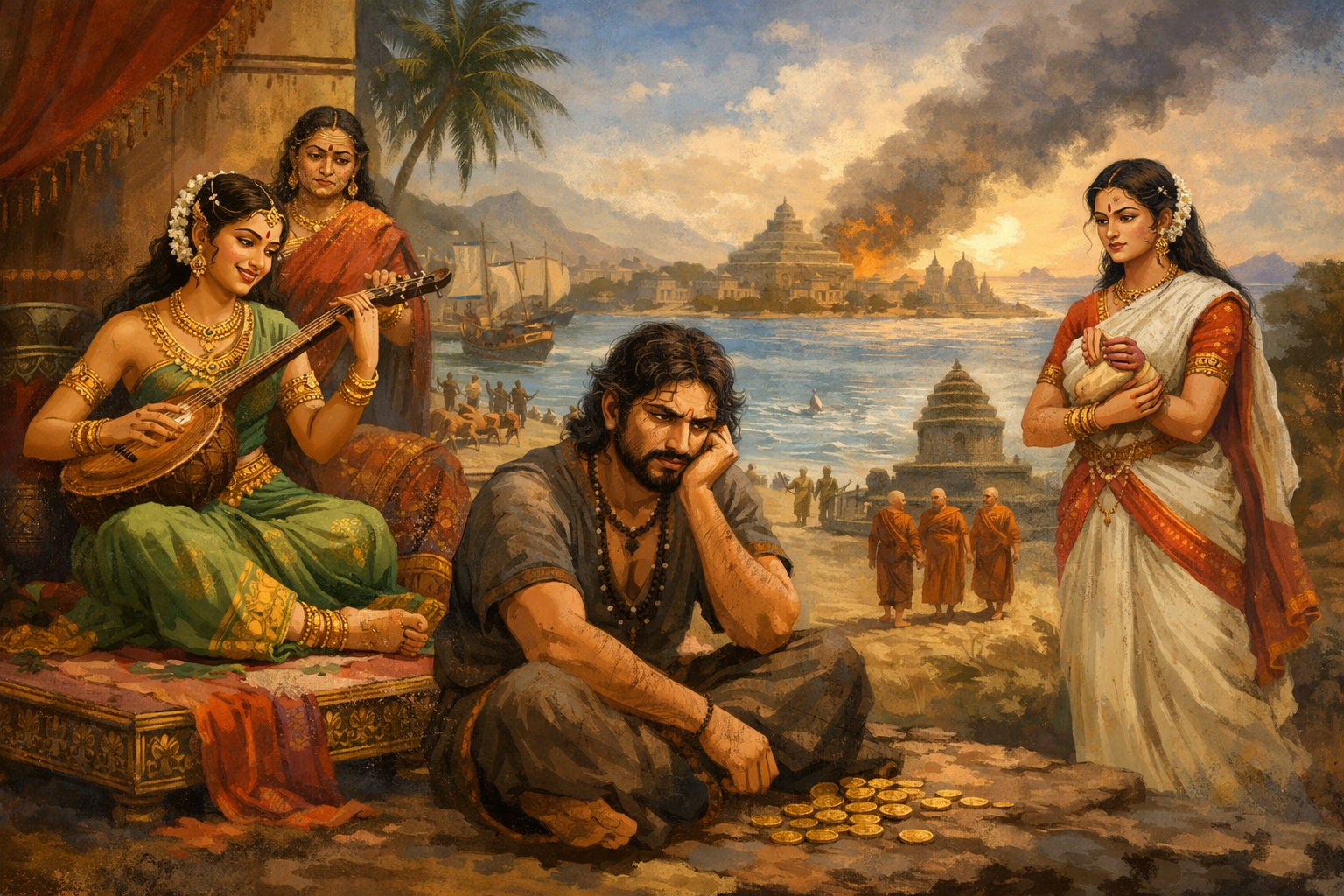
My mother fondly narrates this story about the origin of my name. When I was born—yet another girl—her grandfather apparently said, “Kannagiyin pen Manimegalai aagattum.” And that is how I was named.
Her younger brother is named Ilango, after Ilango Adigal, the author of Silapadhikaaram. So in our family, we have Kannagi, Manimegalai, and Ilango—three names drawn from that great Tamil epic.
Yet, despite this deep connection, I must confess that I have never read Silapadhikaaram in its entirety. Like many others, I have only encountered excerpts from it in Tamil lessons during school and college.
For a long time, I have wanted to read this magnificent kaapiyam. One reason that fascinates me is that Silapadhikaaram tells the story of common people—not kings—set against the rich historical backdrop of South India.
So when I received a book a few days ago, I was eager to begin. Written in English by Vanitha Vaithilalingam, it was gifted to me when I met the author at a common friend’s event.
I read it at one go—that’s how gripping it was.
From the very first pages, the reader is drawn into the world of flourishing Poompuhar, a seaside town present even today. We meet the beautiful dancer Madhavi, whose exquisite Bharatanatyam performances captivate audiences. Wealthy merchants admire her, while her calculating mother Chitrapati watches closely over the riches and opportunities that come their way.
Most of us know the story of Kannagi and Kovalan. Kannagi is revered as a Pathini Deivam, the embodiment of chastity and virtue. But in Vanitha’s retelling, our hearts also go out to the courtesan Madhavi.
She falls in love with the wealthy merchant Kovalan and bears him a daughter—Manimegalai. Kovalan is completely mesmerised by her beauty and charm, losing himself in that world for a long while. Realisation dawns only when his coffers run dry. In that moment of reckoning, he reflects on how he was once a respected man in society, now reduced to someone people mock and speak of with disdain.
Kannagi’s qualities as the patient, dutiful, and forgiving wife are beautifully brought out. When Kovalan returns to her in repentance, she accepts him with grace. At the same time, Madhavi’s character is portrayed with sensitivity—her deep trust in her mother, her helplessness when circumstances spiral out of control, and her eventual stand for dharma.
In a powerful moment of integrity, she returns the riches Kovalan had given her—wealth that her mother Chitrapathi had taken without her knowledge—to Kovalan’s father, Masathuvaan, after Kovalan’s tragic death in Madurai.
The book is wonderfully visual. The descriptions, characterization, and language are all well suited to young readers today. Many may hesitate to pick up the original epic in classical Sangam Tamil—it requires guidance, patience, and time.
But this retelling offers a vivid glimpse into that world:
the thriving port city of Poompuhar with its merchants, silk, and gold;
the presence of Buddhist monks and monasteries;
a society where good and bad people coexist just as in any community;
the flourishing appreciation of the arts.
We also witness the remorse of the Pandya king and queen when they realize that justice was denied because of a grave error in judgement. And, of course, the enduring belief that a chaste woman’s power can burn down a city with the force of her will.
What stood out to me most was how the story enters the mind of the “other woman.” It paints a compassionate picture of Madhavi and the injustice she faces. After all, the life she was born into was never her choice.
I now look forward to reading more works by the author, who is a former Commissioner of Income Tax.
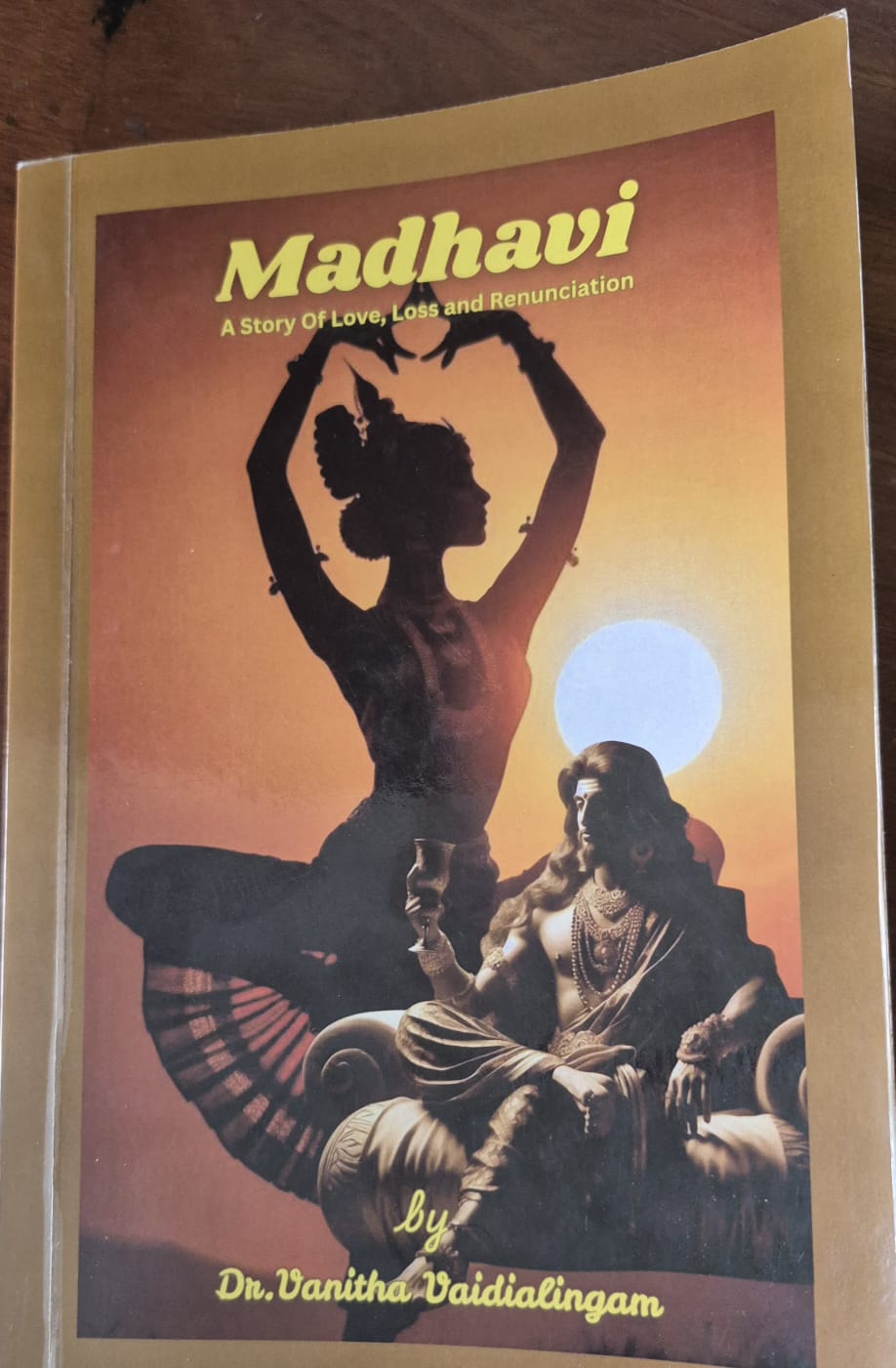
The book is available here:
Amazon
https://a.co/d/b70AJrt
Notion Press
https://direct.notionpress.com/in/read/madhavi
Madhavi: A Story of Love, Loss and Renunciation
Your narration of the story on the great epic, Silappadhikaram is simple and useful to all specially for those who do not know the story.I wish the younger generation gets an opportunity to read some such great epics written as simple stories.Good attempt, well done!
Yes I too have read during school time as a gist of it and not as a full Kaapiyam.
But this seems to be an interesting one without going deep into the original in sangam tamil as you have mentioned.
Thanks for sharing. Let me buy and read it.
Thank you for the review of this book, Megha. I loved the back story about the origin of your name too.
You are absolutely right about the fact that trying to read the original in Tamil may require a lot of time and a dictionary or guidance from someone well versed in Tamil literature. Reading through your review brought back memories of learning Tamil at school. I miss the opportunity to enjoy and appreciate the beauty of Tamil language through literature. I am thrilled to learn that folks like Dr. Vanitha are making such great literary epics accessible to the younger generations. I appreciate you sharing your review on this book and spreading the word. Happy Women’s Day! More power to amazing women like you!
fantastic flashes of powerful writing by the author
the criticism excels as is often said “ poetry excels nature “ the poets mind and thought flow also adds extra flavor to the actual nature similarly the english critical views throws light on where and what for the readers should look into in the main write of silappathigaram and drags the readers minds towards entering the back drop of different characters and justify small lapses in dharma as not so adharmic v good and big hats off to the writer and the supporting critic ♥️♥️