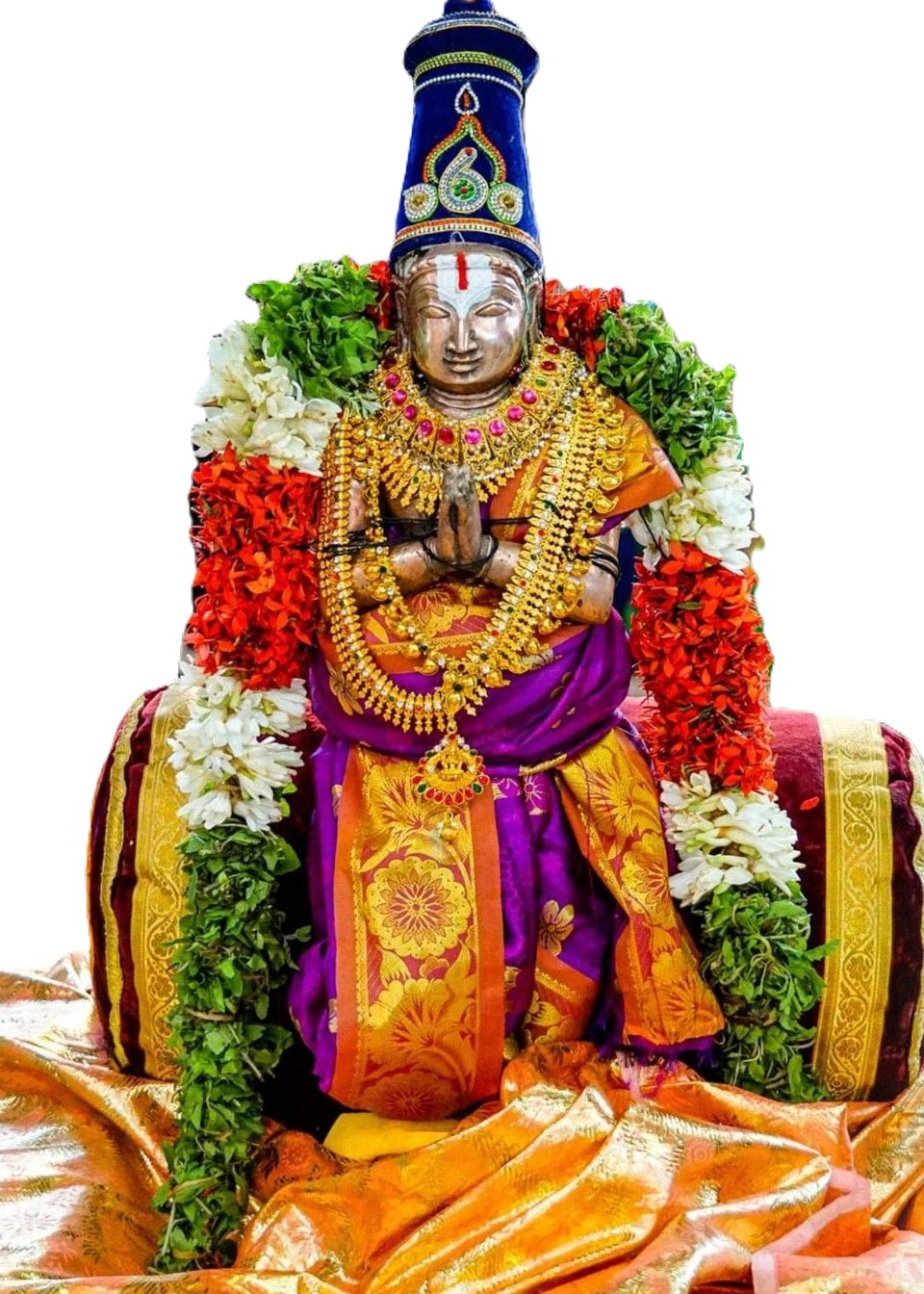
Poigai Alwar
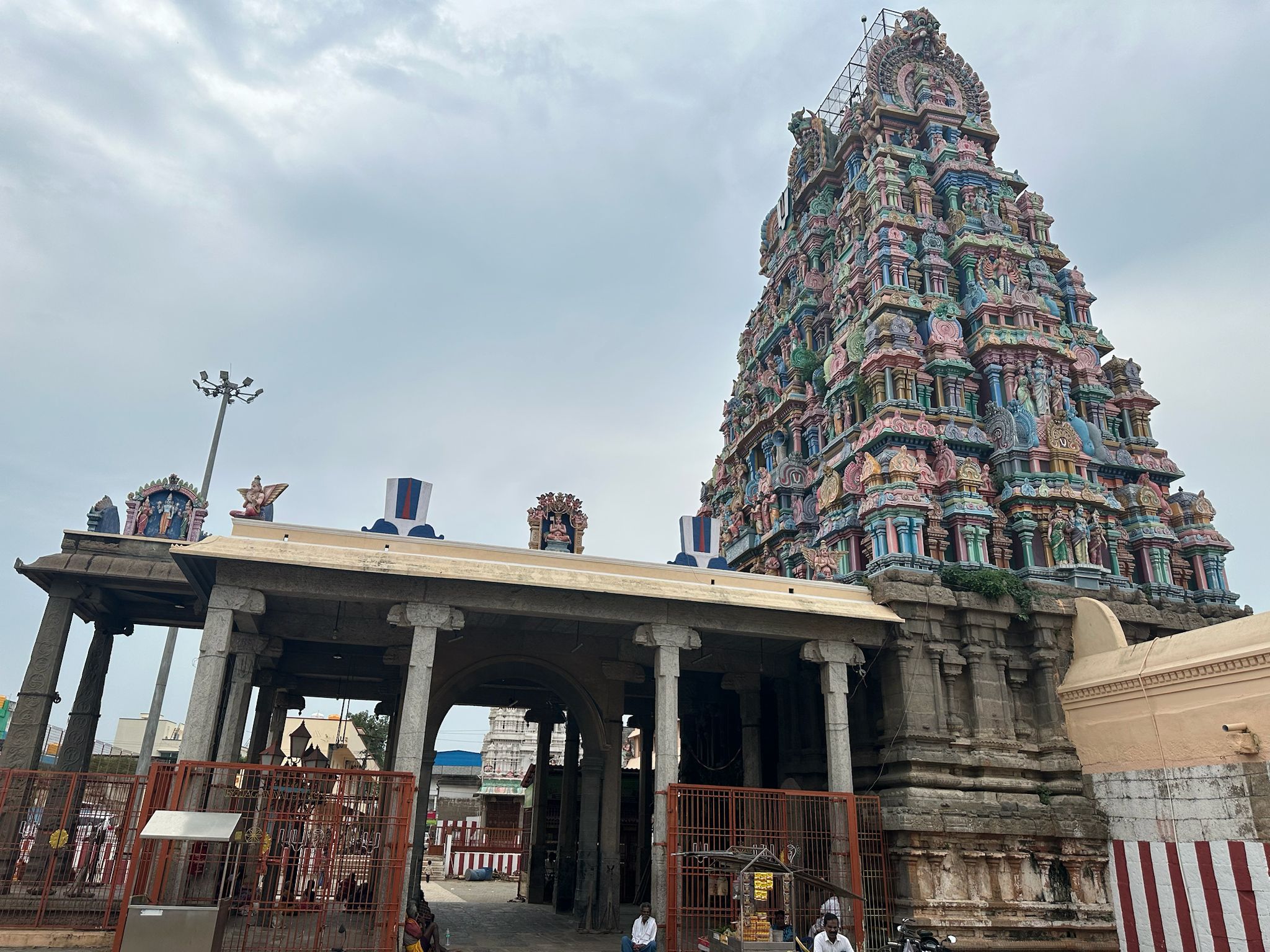
Among the revered Mudhal Alwars, Poigai Alwar occupies a special place in the hearts of devotees. He was born in Thiruvekka, near the sacred shrine of Yathothkari Perumal Temple, also lovingly known as Sonna Vannam Seidha Perumal Temple, in Kanchipuram.
Unlike ordinary births, Poigai Alwar’s appearance was divine. He was found as a radiant infant on a golden lotus in the temple tank filled with red and white lotuses that bloomed every day. In Tamil, “Poigai” refers to a naturally formed water body, unlike a man-made tank known as a “Thadagam.” Since he appeared in this sacred poigai, he came to be known as Poigai Alwar.
He was born in the Tamil month of Aippasi under the Thiruvonam star. Vaishnavite tradition reveres him as the incarnation of Panchajanyam, the divine white conch held by Mahavishnu.
From childhood, Poigai Alwar was immersed in devotion to Narayana. His compassion extended not only towards the Lord but also towards fellow devotees who sought solace and guidance. Longing to experience the divine presence of Srirangam Ranganathaswamy Temple and other sacred Vishnu temples, he undertook pilgrimages to many holy shrines and sang in praise of the Lord.
His hymns were later compiled as the Mudhal Thiruvandhadhi. “Andhadhi” is a unique poetic form in Tamil literature where the ending word of one verse becomes the opening word of the next, creating an unbroken garland of devotion.
Poigai Alwar performed Mangalasasanam in six divya desams, offering hymns soaked in bhakti and philosophical depth.
One of the most remarkable verses in the Mudhal Thiruvandhadhi is the 40th pasuram, where Poigai Alwar beautifully expresses the oneness of Hari and Haran — Vishnu and Shiva.
Aran Naranan naamam, aan vidai pul oordhi,
Urai nool marai uraiyum koyil,
Varai neer karumaa azhippu alippu,
Kaiyadhu vel nemi,
Uruvam eri kaar meni ondru.
In this verse, the Alwar describes the apparent differences between Shiva and Vishnu. Shiva rides the bull, resides in Kailasa, bears the trident, and is associated with dissolution. Vishnu rides Garuda, reclines in the cosmic ocean, wields the Sudarshana Chakra, and is the protector of the universe, dark like the rain-bearing cloud.
Yet Poigai Alwar concludes that despite these outward differences, both are manifestations of the same Supreme Truth. Through this profound insight, he reminds devotees that divinity transcends forms, names, and symbols.
Boothathalwar
The second Alwar, Boothathalwar, was born the very next day after the birth of Poigai Alwar. His avatara sthalam was Mahabalipuram, the ancient port town once known as Thirukadal Mallai. In those days, it was a flourishing seaport bustling with traders, travellers and devotees. Jasmine creepers grew abundantly there, cultivated especially for making fragrant garlands for Perumal. Intertwined among them was the delicate Kurukkathi creeper, also known as Vasantha Malli, bearing beautiful blue flowers amidst clusters of snow-white jasmine blossoms.
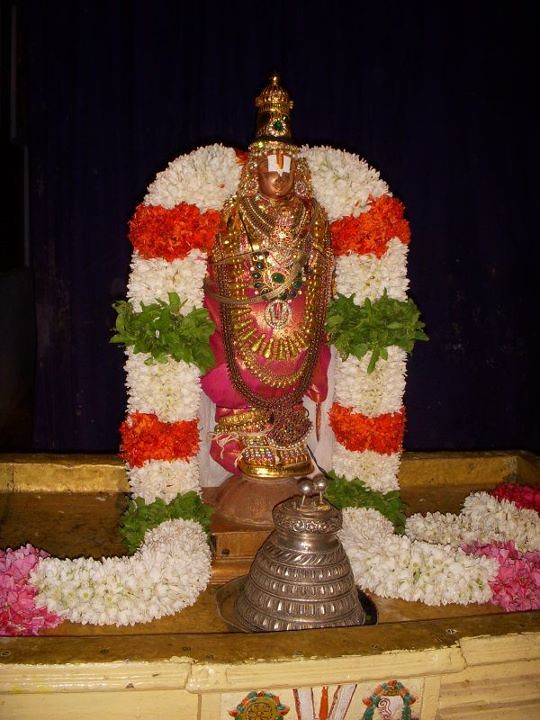
Why was he called “Boothathalwar”? The word “Bootham” here does not refer to ghosts or spirits. It refers to the Pancha Boothams — the five elements that constitute the universe and the human body: earth, water, fire, air and space. Boothathalwar dedicated all these five elements of his being entirely to Perumal.
His eyes longed only to behold the divine beauty of the Lord. His ears desired only to hear the praises of Maha Vishnu. His breath delighted in inhaling the sacred fragrance of flowers adorning the Lord during darshan. His mouth rejoiced in singing His glories. His hands loved to make garlands for Perumal, and his feet found joy only in walking towards temples where the Lord resided. Every aspect of his being was surrendered to Sriman Narayana. Hence he came to be known as Boothathalwar.
Boothathalwar visited several Divya Desams and is believed to have sung in praise of thirteen sacred shrines. His literary contribution consists of one hundred verses known as the Second Thiruvandhadhi. While Poigai Alwar’s hymns are regarded as being steeped in jnana (spiritual wisdom), Boothathalwar’s verses overflow with intense bhakti. His hymns are composed in the poetic metre known as venba.
One beautiful verse from the Second Thiruvandhadhi says:
pinnāl arunarakham sērāmal pēdhuRuvīr
munnāl vaNanga muyalminō pannūl
aLandhānaik kārkkaDal sūzh gyālaththai ellām
aLandhān avan sēvaDi
In this verse, Boothathalwar gently reminds humanity of life’s ultimate purpose. “Why wait until the end of life and fear the blazing fires of hell?” he asks. “Begin now itself to bow before the holy feet of the Lord.” So many sacred texts have already proclaimed His greatness — the Lord who, in His Vamana avatara, measured all the worlds surrounded by the dark blue oceans in just one stride. Surrender at His divine feet now itself, says the Alwar, before time slips away.
Pei Alwar
Mylapore is renowned for the ancient Kapaleeswarar Temple. Yet, nestled close to this famous shrine stands another sacred and ancient temple — the Adi Kesava Perumal Temple. Within the temple premises lies an old well, and inside that well, upon a delicate alli flower (water lily), appeared Pei Alwar, the third of the Mudhal Alwars. He was born the very next day after the avatar of Boothathalwar.
His birth took place in the Tamil month of Aippasi, on a Thursday, under the star Sadayam, on a Dasami thithi. Pei Alwar is revered as the amsam of Nandakam, the divine sword of Maha Vishnu.
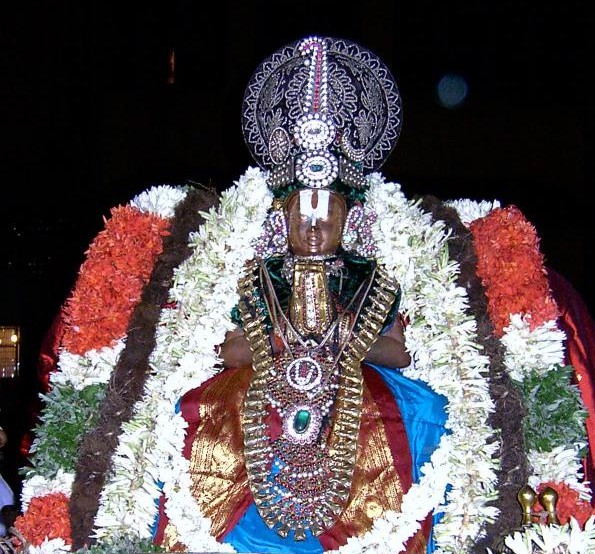
From a very young age, Pei Alwar was immersed in deep devotion towards Sriman Narayana. As he grew older, this bhakti intensified into divine ecstasy. To the ordinary eye, he appeared like one intoxicated with madness. He saw the presence of the Lord everywhere — even in empty spaces — and would converse with Him as though speaking to a beloved companion. At times, he would suddenly burst into dance in overwhelming joy; at other times, tears would stream down his face as he cried out in longing for the Lord.
People around him could not understand this divine state. Some believed he was possessed, while others thought he had lost his senses. Because he appeared like one overwhelmed by a divine frenzy, he came to be known as “Pei Alwar.” Here, the word “Pei” does not carry a negative meaning, but reflects the intensity of his God intoxication and complete absorption in the divine.
Pei Alwar travelled to several sacred shrines and is believed to have sung praises of Perumal at fourteen Divya Desams. His literary contribution consists of one hundred verses compiled as the Third Thiruvandhadhi. Like the hymns of the other Mudhal Alwars, these too are composed in the venba style of Tamil poetry.
One beautiful verse from his Third Thiruvandhadhi says:
poruppidaiyē ninRum punal kuLiththum aindhu
neruppidaiyē niRkavum nīr vēṇḍā — viruppudaiya
Vekkāvē sērndhānai meymmalar thūyk kaithozhudhāl
akkāvē thīvinaigaL āyndhu
In this verse, Pei Alwar conveys a profound spiritual truth in simple words. To wash away one’s sins, he says, there is no need to retreat into mountains for severe penance. One need not stand amidst five sacred fires, nor travel endlessly to holy rivers and ponds for ritual baths. Instead, go with sincere devotion to Thiruvekka, offer pure flowers to the Lord, and worship Him wholeheartedly. In that very moment, sins begin to dissolve on their own before the grace of the Lord.
When the Three Mudhal Alwars Met
Poigai Alwar, Boothath Alwar, and Pei Alwar met under deeply intriguing and divine circumstances, an event that beautifully reveals the spiritual greatness of these three saints.
The three Alwars had all come separately to Thirukovilur for darshan. It is said that the Lord Vishnu himself wished that the three should meet. By divine will, their paths crossed at the ashram of Markandeya Maharishi in Thirukovilur.
Though they had not met before, each immediately sensed the spiritual greatness of the others.
Later that evening, heavy rain began to pour. Poigai Alwar searched for shelter and found a tiny verandah in the ashram. Grateful for the refuge, he lay down there to rest.
After some time, Boothath Alwar arrived, also drenched from the rain and seeking shelter. Seeing Poigai Alwar inside, he hesitated, not wanting to disturb him. But Poigai Alwar warmly said:
“If one person can lie down, two people can sit.”
So the two sat together, speaking about their pilgrimages and devotion to the Lord.
Soon, Pei Alwar too arrived in the rain. Seeing the cramped space already occupied by two people, he turned to leave. But the other two lovingly called him in, saying:
“If two people can sit, three people can stand.”
So all three stood together in that narrow space, immersed in divine conversation.
Suddenly, the three saints sensed that they were no longer alone. Though the tiny verandah could barely hold the three of them, they felt the presence of a mysterious fourth being pressing gently among them. The space overflowed with divine energy.
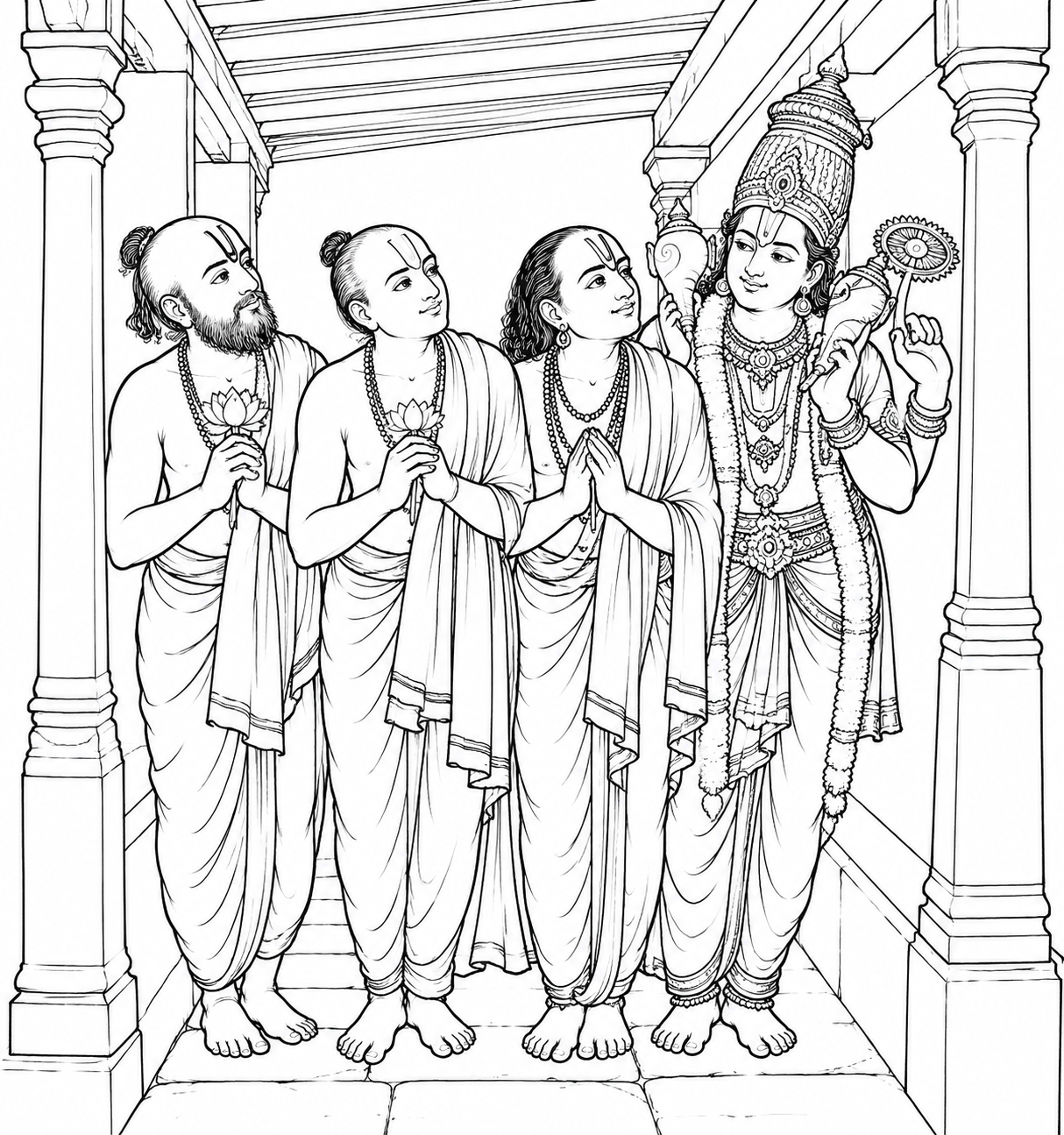
At once, they realised it was none other than Mahavishnu himself.
Overwhelmed with devotion, Poigai Alwar began singing the Mudhal Tiruvandhadhi, describing how divine light dispelled the darkness around them. Boothath Alwar followed with the Irandam Tiruvandhadhi, speaking of the light of devotion that removes inner darkness. Then Pei Alwar sang the Moondram Tiruvandhadhi, joyfully describing the Lord’s divine form revealed before them.
Tradition says that in that sacred vision, the Alwars beheld the Lord together with Mahalakshmi, radiant in divine splendour. Some accounts describe him appearing majestically upon Garuda, while others say he revealed himself reclining upon Adishesha. Yet others associate the vision with Trivikrama of Thirukovilur. Whatever the form, the experience was one of overwhelming divine grace — a vision beyond ordinary human comprehension.
The Lord blessed them with a radiant smile before gradually fading from their sight.
From that sacred moment onward, the three Mudhal Alwars continued their spiritual journeys, spreading devotion to Mahavishnu and singing his glory across the land.
Salutations to the sacred feet of The Mudhal Alwars
Leave a reply