
The Alwars were the twelve great devotees of Maha Vishnu who were born on earth to spread His glory and devotion among people. The Alwars were so completely immersed in devotion and love for Vishnu / Perumal that they came to be known as Alwars — “those who are deeply immersed in bhakti.” Their hymns, composed in beautiful and chaste Tamil, remain among the finest expressions of bhakti in Vaishnavite literature. These sacred verses were later compiled by the 10th-century saint Nathamuni into the Nalayira Divya Prabandham, a collection of four thousand hymns revered as the “Tamil Veda” by Sri Vaishnavas.
The Alwars travelled from shrine to shrine, singing the praises of Maha Vishnu with deep devotion. The temples sanctified by their hymns came to be known as Divya Desams, and there are 108 such sacred temples celebrated in the Divya Prabandham. Even today, these temples echo with the hymns of the Alwars, preserving a spiritual tradition that has endured for centuries.
Scholars generally place the Alwars between the 7th and 10th centuries CE, although traditional accounts and temple legends trace their origins to a much earlier age, sometimes as far back as 6000 to 4000 BCE. Whatever the historical period may have been, the impact of the Alwars on devotion, literature and temple worship remains immeasurable.
According to one sacred legend, after Lord Krishna departed from the world, humanity slowly descended into greed, deceit and selfishness. Dharma weakened, and goodness began to fade from people’s hearts. Maha Vishnu, reclining upon Adisesha, the serpent, in the celestial ocean, looked upon the suffering of the world with concern. Seeing His silence and sorrow, his consort Mahalakshmi gently asked Him the reason for His worry.
Listening to this divine conversation, the Sudarshana Chakra offered to descend to earth and destroy the wicked. Maha Vishnu, however, smiled and declined the suggestion. The Lord did not wish to restore righteousness through fear or destruction alone.
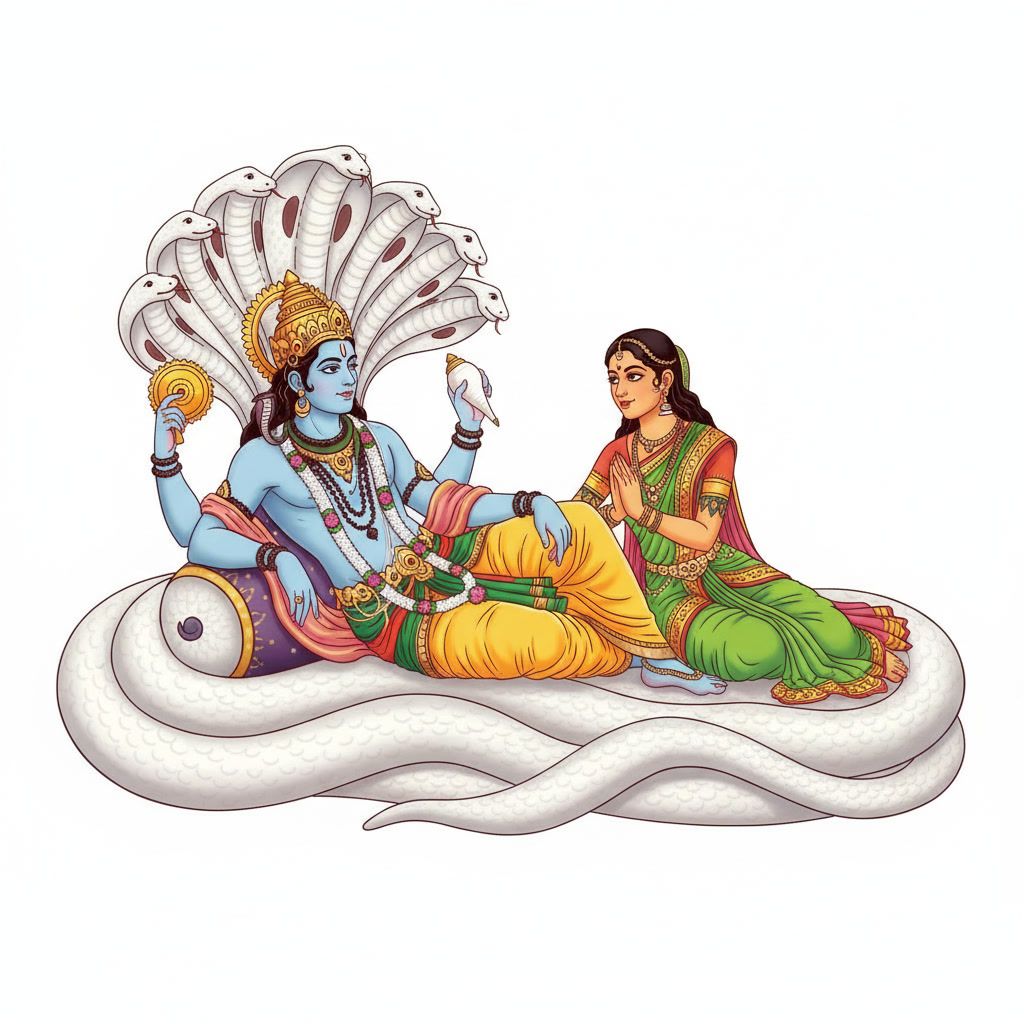
Mahalakshmi then proposed another path. Instead of sending weapons to punish humanity, she suggested that the divine attributes and attendants of Vishnu, such as the Sudarshana Chakra and the Panchajanya conch, should take human birth and guide people through devotion, compassion and wisdom.
Maha Vishnu was pleased with this noble idea and gave His divine consent. Thus, the twelve Alwars descended upon the earth as divine manifestations, carrying within them the radiance of the Lord Himself. They did not come to conquer lands or establish kingdoms. They came to transform hearts through bhakti.
At a time when spiritual values were slowly fading, the Alwars travelled from shrine to shrine, immersed in devotion to Sriman Narayana. Through their soul-stirring hymns, they awakened bhakti in countless hearts and rekindled dharma across the land. Their verses flowed not as mere poetry, but as divine experiences born from complete surrender to the Lord.
The Alwars are revered as manifestations of the sacred attributes, weapons, ornaments and eternal attendants of Maha Vishnu — Panchajanyam, the divine conch; Kaumodaki, the mighty mace; Nandakam, the celestial sword; Sudarshana Chakra, the radiant discus; Vishvaksena, the commander of the Lord’s celestial forces; the resplendent Kaustubha gem adorning His chest; Garuda, the Lord’s divine vahana; Bhudevi Thayar, the compassionate consort of Sriman Narayana; the fragrant Vanamala adorning the Lord; the sacred Srivatsa mark upon His chest; Sharanga, the celestial bow; and Kumuda, the devoted disciple of Vishvaksena.
Through their hymns, the profound truths of the Vedas flowed into the sweet cadence of Tamil, allowing even ordinary devotees to experience the bliss of divine love and surrender.
Another sacred tradition explains the birth of the Alwars through the divine destiny of the Tamil language itself.
According to legend, during the Dvapara Yuga, a great debate arose between Agastya and Vishvakarma, the divine architect, regarding the superiority of Sanskrit and Tamil. As the argument intensified, Agastya became angered and cursed Vishvakarma that his language Sanskrit would one day be destroyed and never recovered. Enraged in turn, Vishvakarma cursed Agastya that Tamil, the sage’s beloved language, would lose its glory in the ages to come.
With the passing of time, Agastya regretted his anger and prayed deeply to Maha Vishnu. The compassionate Lord appeared before him in a divine vision and assured him that Tamil would once again rise in greatness. He promised that a sacred body of hymns would emerge in Tamil and illuminate the world with spiritual wisdom.
In fulfilment of this divine promise, the Alwars were born as extraordinary saints, scholars and devotees. Through their deeply moving hymns, they transformed Tamil into a language of divine experience and spiritual surrender. Their verses spoke not only of philosophy and devotion, but also of love, longing, compassion and the soul’s eternal yearning for the Lord.
Through the voices of the Alwars, Tamil became not merely a language, but a sacred path to the divine. Their hymns continue to resonate through ancient temple corridors even today, carrying the timeless message of devotion to Maha Vishnu across generations.
The simple and free flow language of yours easily reached every reader.Icame to know so many new divine matters . particularly about Alwars birth and the divinity of Tamil. Hats off Megalai.God bless you.Im eagerly waiting for the next chapter.
What an absolute delight reading about Alwars! I feel blessed reading about our rich history and culture masterfully articulated by you, Megha! You are indeed a chosen one for this meaningful work. Keep them coming! 🙏
Nice work, traditionally or vaishnavites belief is that only 10 Alwars existed in spreading vaishnavism but u have mentioned as 12.Any specific reason?
Thats news to me. I have read and listened to scholars talking about 12 only. Which are the 10, can you throw light?
Poigai Alvar
Bhuthalvar
Peyalvar
Nammalvar
Tirummalisai Alvar
Kulasekhara Alvar
Periyalvar
Thondaradippodi Alvar
Thiruppan Alvar
Thirumangai Alvar
The other 2 included might be Andal and Madhurakavi Andal
Thnx Koki. So the list did not have Andal and Madurakavi alwar!
Megha another great work! This has given a very clear intro not only to Alwars but to Vaishanavism as well. The reader will now appreciate how interesting the other chapters will be. I am sure the book is available in tamil also. Keep the good work coming. Krishnaarpanam. 🙏🏽🙏🏽🙏🏽
Waiting for more to come.sure your book will be reference to future scholars.
Am awestruck again … Akka, the comprehension and explanation of the same in layman terms is brilliant. Pls continue doing this seva🙏🙏🙏.
Love you loads🫂🫂🫂
Alwars’ story made an interesting and comprehensive reading. Hope the remaining chapters give many hymns to kindle/recall for readers. All the best!
Excellent reading and good clarity on Descent of Alwars.
Nicely written.Couldnt help comparing Maha Vishnu’s purpose of creating the Alwars with Allah’s purpose of inspiring many human beings to become prophets of Islam chief among them being Prophet Mohammad!!So very similar!!🤔
Excellent writing about Alwars and beautiful explanation as to why they descended on earth. Tamil Veda emergence is also a good highlight.
Appreciate your outstanding effort and understanding.
🙏🙏
Enjoyed reading the detailed description of the original of Alwars.I can understand the efforts put in by you to collect the details. Really commendable.
Excellent. I had absolutely no knowledge of this. Thank you for sharing and congratulations.
Beautifully written, very lucid, in depth infm. Appreciate the language and style of informing, minute things of the Alwars..
Enjoyed reading it.
Brought out all the information and presented very well…taken lot of effort…thanks for sharing
Thanks a lot.
A great write-up; short and very meaningful for an ignorant person like me. My sincere appreciation for the noble efforts.
Om Namo Narayana. 🙏
Thanks for sharing. Senthil had given me a copy of your book in July. Your message served as a reminder and I read it yesterday. Good account of life and glory of the Alwars. Well written.
I went through the writeup on “Alwars” wonderful piece of work nicely structured and narrated. You have brought about Alwars, their origin and their devotion in such a way that it has knowingly or unknowingly created in us a strong feeling of goodness, devotion and bakhthi which will remain entrenched in our minds. You are a blessed one and God will always be with you in your future endeavours.
You have beautifully narrated the glory of Alwars and their extraordinary contribution to Tamil devotional literature.
They transformed profound Vedic wisdom into soul-stirring Tamil hymns, making divine love and spiritual surrender accessible to even ordinary people.
Thank you Madam for sharing this. I thoroughly enjoyed reading this article/ chapter.
Such a short crispy and neat description of the origin of Alwars for people like me who never had the patience to read huge contents in any type of books or narrations.
Love to read again and again to enjoy the beauty of your simple but impressive Tamil.
Lovely, Megha. So beautifully written and so interesting. Looking forward to reading more.
Very divine and thought provoking article. It reminds me of my younger years during Markazhi bajans.