
It was a Pradosham evening. Around 5 pm, we parked our car at the temple entrance. The first act, as always, was to offer our respects to Surya Pillayar—a magnificent, towering form of Ganesha, striking in both scale and presence right at the entrance. From there, we walked barefoot into the ancient Kaameswarar Temple at Madavilagam, Kalkulam village, carefully watching our steps on the rough terrain.


Kalkulam is our ancestral village. Senthil’s thatha and paati lived here, and every visit stirs a deep yearning in my heart—that someday, this temple must be restored. That long-held wish has now been answered. Restoration work has finally begun.
This quiet village lies off the ECR, beyond Kalpakkam. After crossing the Paalar bridge, one turns right at Kathaankadai and drives via Anaicut for about 12 kilometres. Google Maps leads you without fuss. Alternatively, one may approach via the Chengalpattu–Madurantakam National Highway, turning left at Padalam and driving about 27 kilometres through Thachur, Karuppur, and Nelvoy.
The temple makes for an easy day trip from Chennai and can be combined with visits to nearby sacred sites such as Natham Champakeswara Temple, Parameswaramangalam Kailasanathar Temple on the banks of the Paalar, the Vijayanagar-period Vittala Temple on the ECR, and the Thiruvidanthai Nitya Kalyana Perumal Temple, one of the 108 Divya Desams. En route, devotees can also visit Sthala Sayana Perumal at Mamallapuram, another Divya Desam.
As we entered the temple, five villagers sat in a circle in the stone-pillared mandapam. There was an easy camaraderie among them—light-hearted banter, shared laughter—while their hands worked diligently, cutting fruits for the sacred Panchamirtham, to be used in the Pradosha Abhishekam for Lord Shiva and his devoted Nandi. Before the rituals began, I completed a quiet pradakshinam.


Stone inscriptions within the temple grounds stand as testimony to its Pallava origins, dating back over 1,300 years. While the temple retains its Pallava architectural core, later Chola and Nayak contributions are evident in several additions. Stucco figures of celestial beings and a metal bell from the British period add further historical layers to this sacred space.
Standing before Lord Kameswarar in Shiva Lingam form, I then walked through the praharam, admiring the sculpted pillars—likely Nayak additions. Kariya Manikka Perumal, facing west with Sridevi and Bhoodevi, stood majestically. His orientation is unusual, suggesting that He might have been added later from somewhere else. The Lord holds the Sudarshana Chakra as a Prayoga Chakram, poised in divine readiness to protect devotees and destroy evil.

Moving ahead, my eyes rested on the divine line up —Lord Ganesha followed by the Naalvar saints: Appar, Sundarar, Manikkavasagar, and Thirugnanasambandar. Nearby stood the Saptha Maathrikas, whose symbolism I was reminded of through a recent discourse—seven manifestations of Shakti, each corresponding to an endocrine centre/the chakras in the human body, a remarkable convergence of spirituality and ancient wisdom.These Saptha Maathrikas as well as the Naalvar saints are a common feature in several temples. My mind voice was chanting Parashaktih paranishtha pragyana ghanarupini Madhvi panalasa matta matruka varnarupini.
One of the temple’s most striking features is the life-sized Vyagrapadhar (Puli Kaal Munivar). Legend says he worshipped Lord Kameswarar with Vilva leaves at several temples in Thondai Naadu, and this murthy is believed to be the largest of its kind in India. Standing before him, I realised this alone makes the temple uniquely significant.

After offering prayers to Dakshinamurthy, serene in yellow and seated in deep meditation, I proceeded to the Murugan sannidhi in the north-east corner crossing the Vishnu Murthy at the Goshta/Niche behind the garbagriham.

With six faces and twelve hands, astride his peacock and flanked by Valli and Devasena, the Lord radiated grace. Vaikasi Visagam is especially sacred here, drawing villagers who fill the long stone corridors with chants of “Vetrivel Muruganukku… Arohara!”
Sunlight streamed in through small windows lining the praharam. Through one, I glimpsed the temple tank, brimful with water, while another tank at the front lay dry. The floor was adorned with beautiful kolams drawn by village women. After worshipping Durga and Chandikeswarar in the goshtas, I bowed to the south-facing Kaala Bhairavar before returning to the mandapam.


By then, the temple had come alive. Devotees arrived carrying milk in steel thookus, flowers, and coconuts. Panchamirtham awaited its sacred purpose, water vessels were arranged, and archanai trays placed around Nandi and the wooden kodimaram. Children ran freely, joyfully—so unlike city children searching for entertainment via devices. Teenage girls wore bright churidhars; a newly married woman, visiting her maternal home, was surrounded by friends her age enquiring about her new life. A pregnant woman, in post valaikaapu state, sat comfortably against a pillar, her mother watching over her. Her glass bangles tinkled while she basked in all the attention.
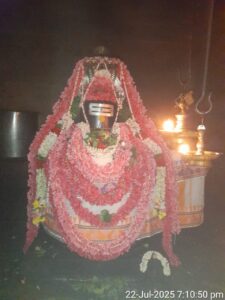
The electric drums thundered signalling that the Abhishekam was about to begin. As devotees lined up, bronze utsava murthis gleamed in the background. My eyes lingered on Nataraja and his Thookiya Thiruvadi—utterly mesmerizing. Tore my eyes away to witness the Sandhana Abhishekam on the moolavar/main deity.


After the Abhishekam for Kameswarar, Nandi’s Abhishekam followed. Kokilambaal, adorned in a radiant orange sari, appeared resplendent—small in stature, immense in grace. It is said that both Kameswarar and Kokilambaal fulfil devotees’ wishes, and it showed in the many villagers named Kokila and Kamesh.


Temple restoration is now underway—perhaps after centuries. Once the stone walls were cleaned, countless sculptures revealed themselves in the inner praharam. The Pallava core, Chola expansions, and Nayak artistry now stand visible once again. Inscriptions on the rear of the main sannidhi await scholarly deciphering, holding untold stories of devotion and patronage.


Be a Part of This Thiruppani
Devotees who wish to contribute to the ongoing restoration may do so through:
- Bank: HDFC Bank
- Branch: Shenoy Nagar
- Account Name: Samskaara Trust
- Account No: 50100857137732
- IFSC Code: HDFC0001587
May this ancient temple stand renewed, its grandeur restored, its single-kaalam pooja blossoming into three-kaalam worship, drawing devotees and sustaining the Gurukkal who serve here.
May Vyagrapadhar samedha Kameswarar and Kokilambaal continue to bless all who enter this sacred space.


Was thinking of being this pradosham at thirukameshwarar but couldnt make it…
And here Akka u bring this wonderful narration like a live cast in front of my eyes so vivid ….🙏🙏🙏om namashivaya🙏🙏
And reading the last para brought intense tears as prayers..
HE shall for sure bring us the joy of witnessing all the older divine occasions in its original spice with a plated kodi maram within 2027 chithirai thingal
Shivaya namah om🙏🙏🙏
Cant help ka its more personal post this time….still with wet eyes
Jai. It will happen. the time has come for a new lease of life for this ancient marvel. Kameswarar will keep showering blessings with more vigour.
Great pictures being coupled with fantastic descriptions brings a picturesque sense. 🙇🙏🏼
what an inspiring , couple -the writer and her hubby God has knit together being so dharmic by thought ( both of them) -by words ( literary flow of language by the lady ) and by act ( predominantly by senthil the husband- whose contribution towards temple renovation has been submitted as homage to his parents and ancestors and through them to the lord or their family deity)hats off to the couple and seetha and her family
Words can’t describe the feeling of peace that I feel as I read through your post, Megha. Your words transport me to these temples looking through your eyes, feeling the air around, listening to every sound and taking in the divine vibrations around. You are a gifted writer and it is my strong belief that you are silently transforming lives sitting behind a keyboard. I feel inspired, blessed and grateful for all that you do. You are a true embodiment of Shakthi herself! Thank you!
Very well written…got a feeling of visiting the temple with you
Beautifully written ma’am! Your vivid narration brought the ancient Kaameswarar Temple to life (as always…. that’s your strength ma’am) — I could almost walk through its stone corridors and feel the sacred energy. Inspiring to see heritage being restored with such heartfelt devotion. 🙏