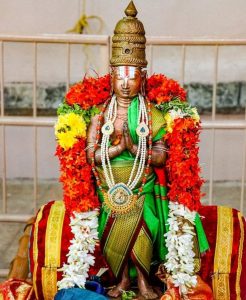
Madhurakavi Alwar was born in the Pandya kingdom, at Thirukolur near Thoothukudi. He was born in the Tamil month of Chithirai, under the star Chithirai. Tradition also reveres him as the incarnation of Kumudha Ganesha, a disciple of Vishwaksena, the celestial commander of Mahavishnu.
Among the Alwars, Madhurakavi holds a unique place. While the other Alwars were immersed in devotion to Mahavishnu, he dedicated his life to singing the praises of another Alwar — Nammalwar.
From a young age, he displayed a gift for composing beautiful devotional poems that were sweet to hear. The word “Madhuram” means sweetness, and because of the sweetness of his verses, he came to be known as Madhurakavi.
His life’s mission was to travel from place to place singing the glory of the Lord. During one such pilgrimage, he reached Ayodhya. Even while staying there, he would face the direction of Thirukolur while praying.
One day, he saw a mysterious divine light in the southern sky. The light appeared continuously for three days. Believing it to be a divine sign, he followed it. The divine light finally led him to Alwarthirunagari, where he found the young saint Nammalwar seated in deep meditation inside a tamarind tree.
The child saint had never spoken before. Wanting to draw his attention, Madhurakavi gently threw a small stone near him. Nammalwar opened his eyes. Madhurakavi then asked a profound question:
“Setthathin vayittril siriyadhu pirandhaal eththaith thinru enge kidakkum?”
“If the small one is born inside the dead one, what will it eat and where will it stay?”
Nammalwar replied:
“Aththaith thinru ange kidakkum.”
“It will eat that and stay there.”
Spiritual Meaning
In Sri Vaishnava philosophy:
- The “dead one” (setthathu) refers to the physical body, which is inert and lifeless by itself.
- The “small one” (siriyadhu) refers to the soul (jeevatma), which resides inside the body.
Madhurakavi Alwar was asking:
When the soul is born into and trapped within this material body, how does it survive and where does it remain?
Nammalwar’s profound answer means:
The soul experiences the world only through the body, feeds on the experiences connected to the body, and continues to remain within that very body.
On a deeper level, it also signifies:
- The soul becomes attached to worldly pleasures and pains through the body.
- Until divine grace is attained, the soul continues its existence bound within material life.
From that moment, Madhurakavi Alwar recognized Nammalwar as his guru and became his ardent disciple, even though Nammalwar was much younger than him in age. For Madhurakavi, his guru was everything — even greater than the Lord Himself.
According to tradition, Madhurakavi Alwar boiled the waters of the sacred Tamiraparani River and from it manifested a Thiru Uruvam (sacred image) of Nammalwar. He worshipped Nammalwar with the same devotion and reverence that others offered to Perumal. Through his life, Madhurakavi demonstrated the greatness of Guru Bhakti — complete devotion to one’s spiritual master.
Madhurakavi Alwar also played a vital role in preserving the hymns of Nammalwar. He carefully compiled and propagated the divine songs of his guru, ensuring that they would be passed on to future generations.
He composed only eleven pasurams, collectively known as Kanninun Siruthambu. Though small in number, these verses are regarded as spiritually priceless. In them, he declares that chanting the name of his guru is sweeter than tasting nectar itself. One of the central ideas in his hymns is that the devotee of the Lord is as worthy of reverence as the Lord Himself — “Adiyaar aandavanaaga” — seeing the devotee as divine.
The eleven verses of Kanninun Siruthambu later became deeply significant in the Vaishnavite tradition. Centuries later, Nathamuni is said to have chanted these eleven verses 12,000 times in deep devotion to propitiate Nammalwar. Pleased by his devotion, Nammalwar blessed him with the recovery of the lost Naalayira Divya Prabandham — the four thousand sacred hymns of the Alwars. Thus, the eleven verses of Madhurakavi Alwar became the spiritual key to restoring the entire Divya Prabandham.
Tradition also says that his hymns were tested on the famous Sanga Palagai in Madurai. It was believed that only flawless literary works would remain upon the sacred plank, while inferior works would fall into the temple pond. While many poets’ compositions were rejected, Madhurakavi Alwar’s verses were accepted and praised by all.
Though he sang only eleven songs, their spiritual depth and devotion to the guru earned him an eternal place among the revered Alwars.
Very well interpreted and expressed. It makes you think and introspect the meanings in the scriptures. 🙏
Excellent write-up on Madhurakavi Alwar,Your research is truly admirable.The way you highlighted his unconditional devotion to his Acharya Nammalvar is very touching. Keep writing.
As usual nicely presented. Matha pitha guru deivam is the order to respect.
Pray to God to bless you with good health and happiness to contribute more
Falling as a Beautiful sequel to
Nammalwar as he is met by Madhurakavialwar and curious questions on body and soul asked by him and clarified impact-fully by the predecessor.
Kannanin Siruthambu.
Finest illustration of gurubakthi
Adiyan aandavanga
Restoration of Nalayira Divya prabhandam
Sangapalagai Madurai capturing only intensely divine versus others fading away
All make it very interesting reading
Let me confess i was more attracted to Nayanmars all these years as Eswaran temple daily used to go at 5 am for many many years for singing thevaram in my schooling years at Karur. Hence less attracted towards Alwars but now it is changing and for that too thanks to you.
Amazing to hear the background story of the Madhurakavi. So interesting and enlightening. Thanks Meku🙏🏼