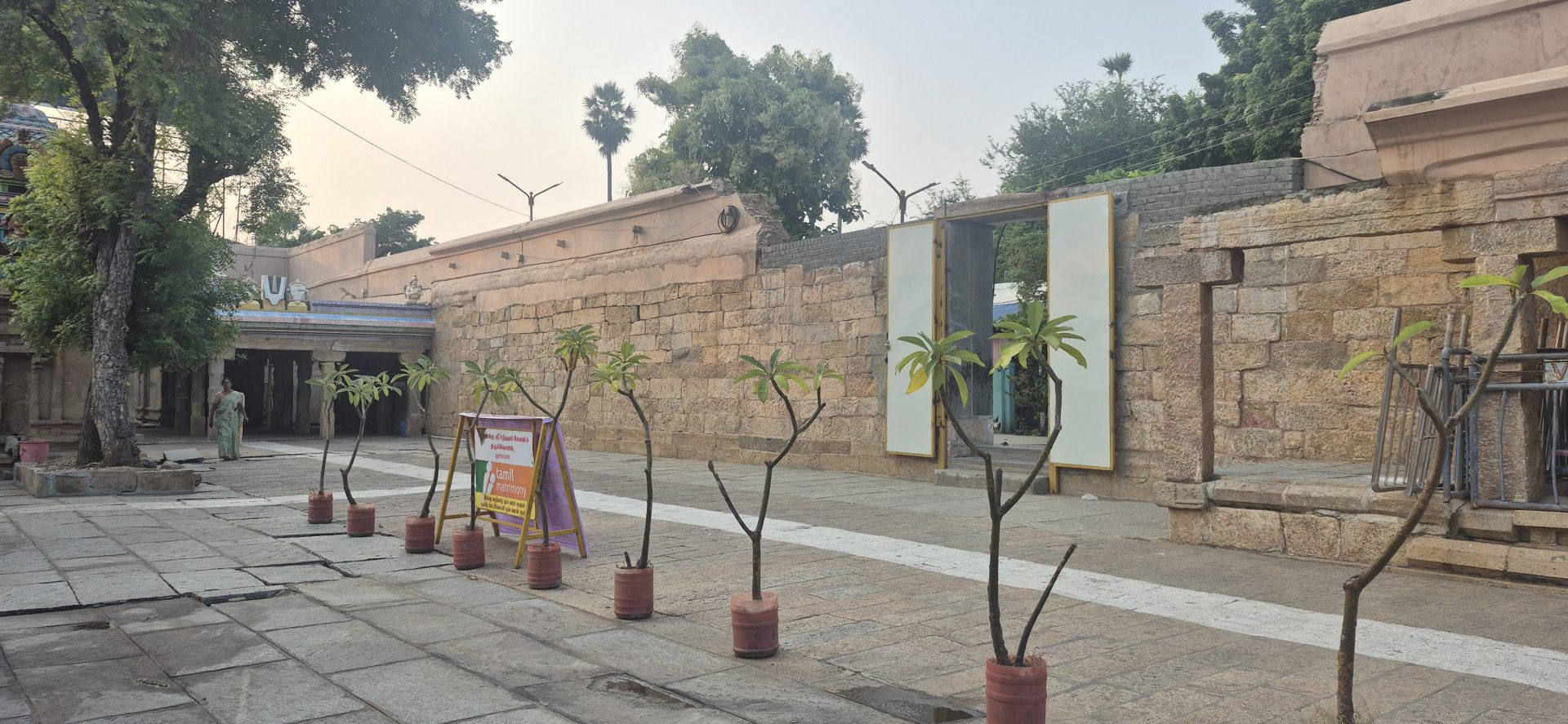
There are times when a temple catches your eye even before you know its name. On one of our earlier visits to Trichy, while zooming over a flyover, I happened to see an amazing sight. An ancient temple stood majestically, seemingly untouched by colourful paint, with towering reddish granite walls and exquisite sculptures. It looked sprawling and grand. I remember being fascinated by the sight.
Recently, the wish to visit that temple finally came true. Senthil and I visited Uthamar Kovil, one of the 108 Divya Desams, and the third Divya Desam in the Chola Nadu region.
The temple was undergoing restoration when we visited. We walked in at around 4.30 pm.
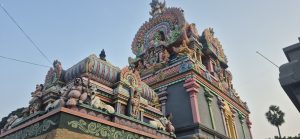
Quick points for temple travellers
Location
Uthamar Kovil, on the outskirts of Trichy, along the Trichy–Namakkal road, approximately 3 km from Srirangam.
Deities
Purushottamar (Vishnu), Bikshadanar (Shiva) and Brahma, along with their consorts.
Significance
A 108 Divya Desam sung by Thirumangai Alwar and also a Shiva Vaippu Sthalam.
A temple where the Trinity reside
Uthamar Kovil is special because it houses the Trimurthis, Brahma, Vishnu and Shiva, each with their own sannidhi, along with their consorts. It is rare to find all three in one temple complex, and the stories associated with each deity make the visit all the more fascinating.
We often tend to think of temples as belonging to one tradition or another. But here, the Vaishnavite and Saivite traditions coexist beautifully, reminding us that the divine is not limited by the form in which we worship.
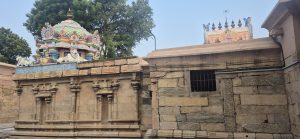
The story of Bikshadanar and Poornavalli Thayar.
The story of Bikshadanar is one that I found particularly interesting.
According to legend, both Brahma and Shiva once had five heads. This apparently led to confusion for Parvati, Shiva’s consort, who mistook Brahma for Shiva. In an act of anger, Shiva severed one of Brahma’s heads.
But the severed skull stuck to Shiva’s hand. To absolve himself of the sin, Shiva took the form of Bikshadanar, a mendicant, carrying the skull as his begging bowl. He went around seeking alms, but whatever was offered into the skull disappeared, leaving him hungry.
It was only when Lakshmi, the consort of Vishnu, offered alms that the skull was finally filled and Shiva’s hunger was appeased.
Here, Lakshmi is worshipped as Poornavalli Thayar, the goddess who filled the bowl and brought an end to Shiva’s hunger. The name itself carries a beautiful significance, and devotees believe that she fulfils their wishes and brings abundance into their lives.
Shiva is worshipped here as Bikshadanar, in the form of a Lingam.
Brahma’s devotion to Vishnu
Another legend associated with this temple is that Brahma once felt saddened that there were hardly any temples on earth dedicated to him.
He approached Vishnu and sought his grace. Vishnu took the form of a Kadamba tree, but Brahma recognised him even in that form. With great devotion, Brahma performed sacred Abhishekam to the tree.
Pleased with his devotion, Vishnu blessed Brahma and asked him to remain at this sacred place, giving darshan to devotees along with Saraswathi, his consort.
The Saraswathi here is quite different from the familiar roopam we see elsewhere. She is seen without the veena, holding palm leaves and a japa mala.
Purushottamar, the magnificent reclining Lord
The main Vishnu sannidhi was yet to open when we visited. So we continued exploring the temple, visiting the sannidhis of the Alwars and Acharyas.
We paid our respects to Manavala Mamunigal, Ramanujar and Thirumangai Alwar, who has sung paasurams about this Lord.
Thirumangai Alwar is also associated with Srirangam, where he is said to have stayed during the construction of the compound wall of the Ranganatha temple which was his thiruppani/sacred service.
Purushottamar is seen in a reclining posture, and the Lord was as imposing as Ranganatha of Srirangam. The silver eyes adorning the deity add to the grandeur of the divine form. I couldnt stop looking fearing even to blink. I tried to capture the sight to memory for recall again later. The utsava murthis were also beautifully adorned and graced us with their darshan.
Kamavalli Thayar has a separate sannidhi of her own. We made our way through the temple pradakshinam, taking in the various sub shrines.
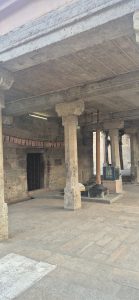
The layout of the temple is quite different from what one would expect. Some sannidhis are tucked away in a manner that one might easily miss them if one did not look carefully. It is a temple that calls for slow exploration rather than a hurried visit.
The magic of Sayaratchai, evening prayer.
As we moved towards the Shiva sannidhi, we saw Bikshadanar murthy in an enclosure with his distinctive alms bowl, next to Dakshinamurthy. We went inside the Shiva shrine just as the Sayaratchai/ evening pooja was about to begin.
The atmosphere changed almost instantly.
The fragrance of sambrani filled the air making it smoky. Devotees with flowers and vilvam/ bael leaves in their hands, gathered in a line, waiting for the Deepa Aradhanai. The temple reverberated with the sound of drums, and an Othuvar began singing Appar’s Thevaram.
“எண்ணுகேன் என் சொல்லி…”
The voice of the Othuvar, the rhythmic beating of the drums, the swirling sambrani smoke, the lamps being waved before the deity and devotees chanting Om Namah Shivaya… it was ethereal.
There are moments in a temple when you don’t feel the need to ask for anything or even think of anything. You simply stand there and absorb it all.
Sculptures that deserve a closer look
As we came out, we explored the other sannidhis and were treated to a series of beautiful sculptures.
Andal was there, followed by Rama with Sita, Lakshmana and Anjaneya. We also saw Krishna, with Rukmini and Satyabhama, and a charming depiction of baby Kannan seated.
Every sculpture was so beautifully executed. The expressions, the posture and the detailing were exquisite.
A Divya Desam and a Shiva Vaippu Sthalam
Uthamar Kovil holds significance in both Vaishnavite and Saivite traditions.
It is a 108 Divya Desam, glorified in the paasurams of Thirumangai Alwar. For Vaishnavites, this makes it an important pilgrimage destination.
At the same time, it is a Shiva Vaippu Sthalam. A Vaippu Sthalam is a sacred place mentioned in the hymns of the Nayanmars, though they are not believed to have visited the temple in person.
It is this combination that makes Uthamar Kovil so special. The temple is steeped in the traditions of both Alwars and Nayanmars, bringing together two streams of devotion that have shaped Tamil spiritual history.
Different forms, different paths, but the divine is one.
Leave a reply