Maharishi Valmiki had completed the magnificent Ramayana, the story of Sri Rama, and was giving the finishing touches to his great epic. He was the one of a kind author, blessed to write the Ramayana while the epic was happening.
Valmiki had named the seven kandams: Bala Kandam, Ayodhya Kandam, Aranya Kandam, Kishkindha Kandam…
When he came to the fifth kandam, which recounts Hanuman’s extraordinary journey to Lanka in search of Sita, the sage thought to himself, Why not call it Hanuman Kandam? After all, the entire chapter revolves around this remarkable devotee of Sri Rama.
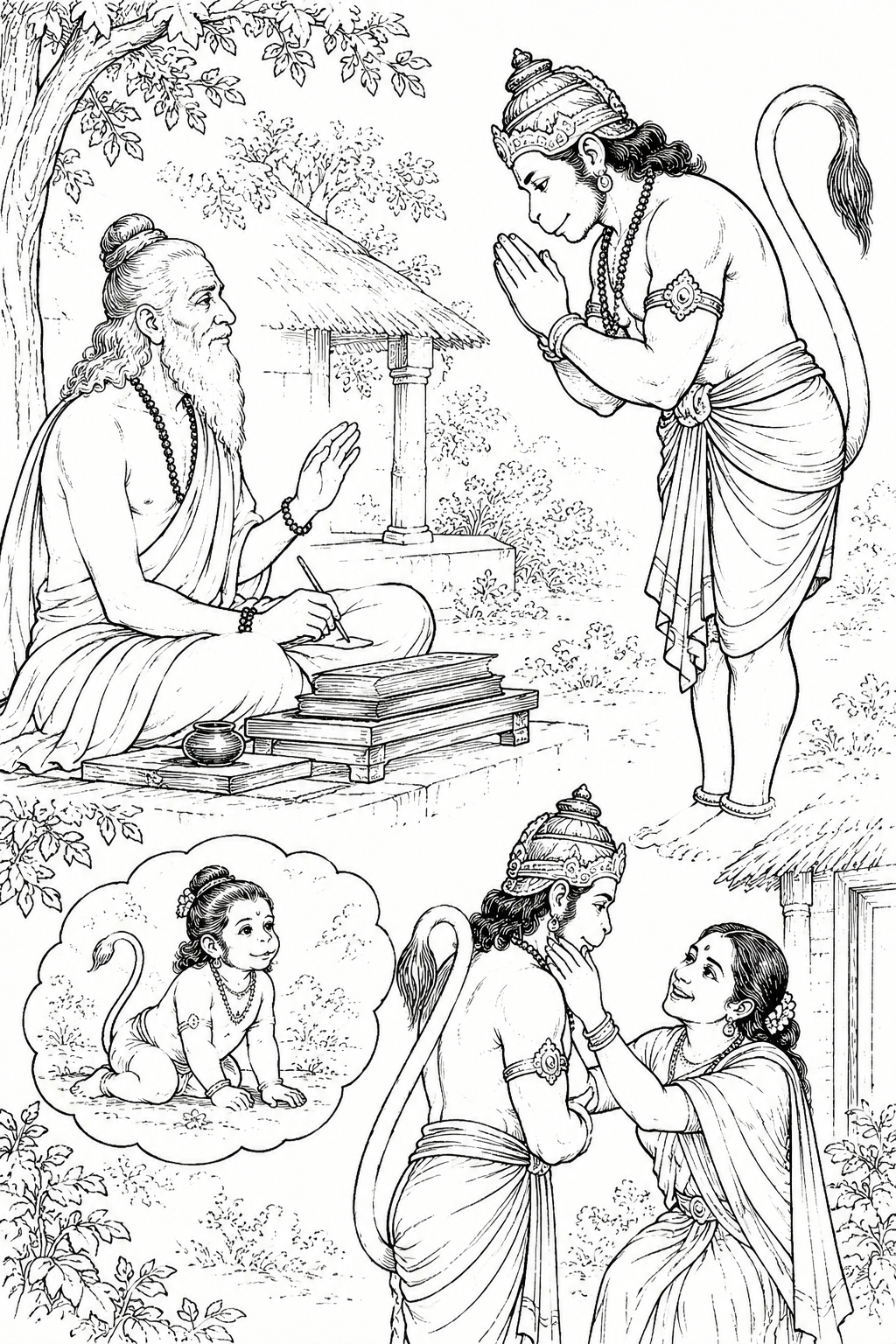
Just then, as though summoned by the very thought, Hanuman arrived at the ashram. He bowed reverentially before the great sage and enquired, “Maharishi, have you completed composing the Ramayana?”
Valmiki smiled. “Yes, O Maruti! I was just naming the seven kandams. And when I came to the fifth, I thought of naming it Hanuman Kandam. After all, you are the hero of this chapter!”
Hanuman was taken aback.
“Please, Maharishi!” he pleaded. “Do not name a kandam after me. This is the glorious story of Sri Rama, the noblest of all. How can I, a humble servant of His, have a kandam named after me? Please name it after my Lord instead.”
“But, Anjaneya,” Valmiki reasoned, “you crossed the mighty ocean, discovered Sita Devi, gave her Rama’s message, and filled her heart with hope. You displayed extraordinary courage, wisdom and devotion. Surely, you deserve the honour!”
Hanuman would have none of it. He pleaded again and again, insisting that the glory belonged to Rama and not to His servant.
At last, Valmiki appeared to give in.
“Very well, Hanuman. I shall not call it Hanuman Kandam. I shall give it another name. Let it be called Sundara Kandam.”
Hanuman was delighted. He bowed to the sage and went on his way, relieved that his name would not grace a chapter of the great Ramayana.
On his way, he decided to visit his mother, Anjana Devi.
Seeing her beloved son approaching from a distance, Anjana called out joyfully, “Sundara! Veera Anjaneya! Come, my son! I was just thinking of you!”
Hanuman stopped in his tracks.
“Amma! What did you call me?”
“Sundara!” she replied affectionately. “That is your name too, my son. You were such a beautiful baby that I named you Sundara. And you have grown into someone beautiful in thought, word and deed!”
Hanuman stood still for a moment. Then the realisation dawned upon him.
Ah! So that was Valmiki’s clever little trick!
The sage had honoured Hanuman after all, without naming the kandam after him directly. Hanuman could hardly object now, for Sundara was indeed one of his names!
And so, according to this delightful traditional anecdote, the fifth kandam came to be known as Sundara Kandam.
Whether we take this as a traditional legend or a charming story passed down through generations, its message is timeless.
We often admire people for their achievements, courage and greatness. But there is something even more beautiful about those who accomplish extraordinary things and yet refuse to claim the glory for themselves. Hanuman, who performed the most incredible feats, considered himself nothing more than a humble servant of Sri Rama.
Perhaps that is the real meaning of Sundara. True beauty lies not merely in what we achieve, but in the humility with which we achieve it.
And that, to me, is what makes Hanuman truly Sundara. 🙏
What a beautiful and heartwarming anecdote!
The charming twist in Valmiki’s choice of Sundara Kandam makes it all the more delightful. True greatness lies not in seeking recognition for our achievements, but in remaining humble despite them. Hanuman is truly Sundara, beautiful not merely in name, but in thought, word and deed.
I have heard this story for the first time. Thank you Mam for sharing this beautiful piece. 🙏
Humility is indeed the real beauty. I will add vulnerability too to the list.
In a world of over achievers and super braggers, thank u for reminding us of this virtue through this poignant blog.
Beautifully narrated, Megu! What makes Hanuman truly extraordinary is that his greatness was boundless, yet his humility was boundless too. Having achieved the impossible, he claimed no glory, surrendering it all to his beloved Rama. Indeed, the beauty of a mighty soul lies in the humility of a devoted heart!