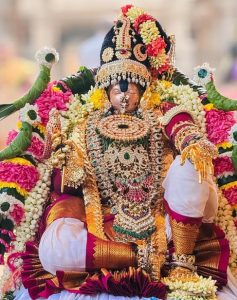
In the lush land of Thirunagari, also known as Thirukurugoor, where the river Tamiraparani flows, was born one of the greatest mystics of the Vaishnavite tradition — Nammalwar. Vaishnavites revere him not merely as an Alwar, but as the very embodiment of divine wisdom. He is believed to be the avatar of Vishwaksena, the celestial commander of Vishnu, and also of the Kaustubha gem that adorns the Lord’s chest. In many ways, he occupies among Vaishnavites the same exalted place that Manickavasagar holds in Saivism.
His parents, Kaari and Udaya Nangai, were wealthy and deeply devoted to Vishnu. Yet their lives carried one silent sorrow — they remained childless for many years. After fervent prayers to the Lord, a child was finally born to them during the month of Vaikasi under the Visakam star. But this was no ordinary child.
The infant neither cried nor smiled. He refused milk and spoke not a word. Yet, strangely, he continued to grow normally, serene and detached from the world around him. His worried parents, unable to understand the mystery surrounding their son, carried him one day to the temple at Thirunagari and surrendered him at the feet of the Lord.
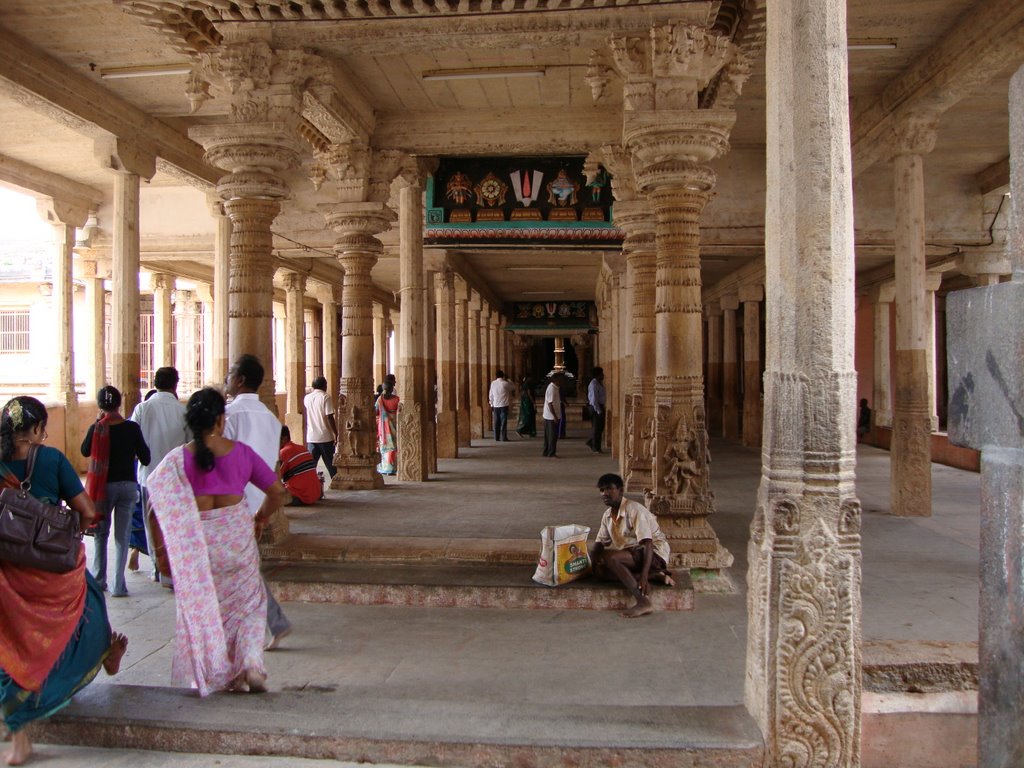
Near the temple stood a sacred tamarind tree beneath which Adisesha himself is believed to have incarnated as Ananthaazhwar. Beneath that ancient tree, the parents gently placed the child in a cradle. Something extraordinary happened thereafter. Days passed, and the child slowly crawled toward a hollow within the tamarind tree. Entering it, he sat in padmasana, immersed in deep meditation.
There he remained for sixteen years.
The villagers watched in awe. A radiant glow is said to have emerged from the tamarind tree, growing brighter with each passing day, so brilliant that legends say it was visible even in distant northern lands. Since the child was unlike any other, people called him Maaran — one who was different from the ways of the world.
Another beautiful legend explains how he came to be known as Sadagopan. It is believed that newborns are troubled by an unseen force called “Sadam,” a restless wind that makes babies cry in discomfort. But when this force approached the infant Maaran, he looked upon it with divine anger and drove it away. The force dared not touch him again. Thus he became “Sadagopan” — the one who conquered Sadam.
From this divine and silent mystic flowed some of the most profound devotional poetry in Tamil literature. Though he had never physically visited the many temples he sang about, through his divine grace and supreme gnana, he described them with astonishing depth and spiritual insight, revealing profound truths that continue to move devotees even today. During moments of divine ecstasy and contemplation, verses poured out of him like the Tamiraparani itself. Though he lived in this world for only thirty-five years, the spiritual treasure he left behind remains eternal.
His four great works are:
- Thiruviruttam
- Thiruvasiriyam
- Periya Thiruvandhadhi
- Thiruvaimozhi
These are not seen merely as poems, but as the very essence of the four Vedas rendered in Tamil. Thiruviruttam is considered the essence of the Rig Veda, Thiruvasiriyam of the Yajur Veda, Periya Thiruvandhadhi of the Atharva Veda, and Thiruvaimozhi of the Sama Veda. Because he gave the wisdom of the Vedas in the sweetness of Tamil, he came to be lovingly called “Vedam Tamizh Seidha Maaran.”
Among these works, Thiruvaimozhi occupies a special place. With over a thousand verses soaked in devotion, surrender, longing, and divine love, it is regarded by devotees with the same reverence accorded to the Vedas themselves. For Vaishnavites, Nammalwar is the Mudhal Aasiriyar — the foremost teacher.
His verses repeatedly return to one central truth — complete surrender to the Lord.
Even the great Ramanuja held Nammalwar in the highest reverence.
One of his most celebrated paasurams begins thus:
uyarvaRa uyarnalam udaiyavan yavan avan
mayarvaRa madhinalam aruLinan yavan avan
ayarvaRum amarargaL adhipathi yavan avan
thuyaraRu sudarodi thozhudheLu en mananE
The verse calls upon the heart to arise and worship the Lord — the One beyond all greatness, the One who removes ignorance and grants pure wisdom, the Lord of the immortal devas.
Even today, in Vishnu temples, devotees receive on their heads the sacred Sadari or Sadagopam — the small crown-like object bearing the divine feet of Vishnu. It is named in honour of Nammalwar himself.
When the priest gently places the Sadari upon the devotee’s head, it symbolizes something deeply moving — the touch of the Lord’s feet upon the soul. In that brief moment lies the essence of Vaishnavite philosophy: humility, surrender, and the dissolution of ego before the Divine.
Salutations to the sacred feet of Nammalwar
My heart filled with joy and an inexplicable sense of calm as I read this story of Nammazhvar. I enjoyed learning about Sadari as well. Thank you, Megha, for this wonderful story. I look forward to the next one!
Wonderful presentation 👏 👌 👍
Informative and nicely presented. God bless. Wish you good luck for many more brilliant works.
Superb reading.
Got understood why in north people are named Kastuba. Remember Had one loyalty programme vendor in that name while at HO.
Nammalvar is the vashnavaite’s Appar.
Sadagopan real meaning is a revelation. Will get a different divine feel whenever I go for Dharshan to Perumal temples and Sadagopan is kept in the head as a blessing.
Maaran ( Vedham Tamil Seidha Maran ) will be able to connect with Nammalvar whenever I meet some friends who are there in the name of Maaran.
Excellent coverage
awesome gift for divali in the form of illuminating flash of gnana deepa ஓளி ,அழுத்தமான இறவனிடம் பந்தம் நாம்சுவைக்கும் நாவில் ஒட்டும் பாதாம் அல்வாப்போல் , ( இன்றையபாஷையின் அல்வாக்கொடுப்பது போல்இல்லை) பழையவேண்டாத உடைகளை களைந்து புதிய இறைஉணர்வோடு தரியில் நைய
யப்பெற்ற ஆடைகள் அத்தனையும் சீராய் கொடுத்த வள்ளல் மேகலாசெந்தில் 🙏🙏
Namazhwar occupies the supreme position amongst all Alwars. HIS great works came to light with the efforts of Acharyan Nadamuni thru Madurai kavi Azhwar.
Madurakavi Azhwar was his devoted disciple who considered him as his only God.
I am sure the riddle posed by Madurakavi Azhwar to Namazhwar and latters response…
Angai thindra Angai Kidakum ..would be highlighted in Madurakavi Azhwar story later.
Looking forward.
Megha, what a rich spiritual insight and knowledge of ancient Always the articles depicts. I’ve only heard the name of Nammalwar. Your writings literally transports us to a bygone Age ! So blessed to read these articles. Your effort, time , interest and explanation of chaste Tamil poems, is indeed a pleasure and an amazing understanding to the power of a devotee in invoking PERUMAL to obedience !! Thank you so much. Looking forward to more such divine experiences.
👌👏👍
A beautiful narration of Nammalwar’s divine wisdom and devotion. The special mention of Sadari was particularly enlightening, adding a deeper spiritual meaning to a familiar temple ritual. 🙏❤️