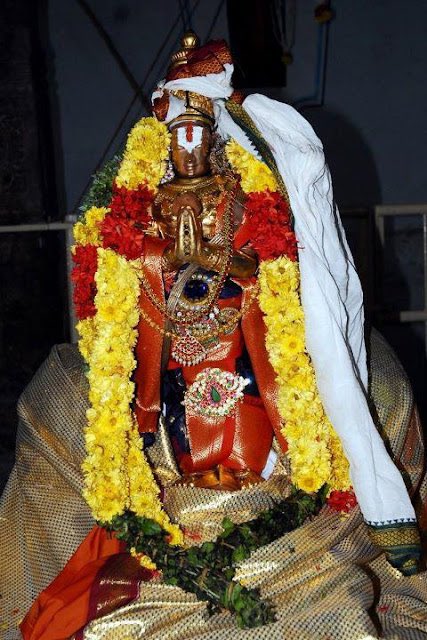
Among the twelve Alwars, Kulasekara Alwar stands apart as the king who willingly gave up his kingdom for the joy of serving the Lord and His devotees. Born in the Chera kingdom, in a place called Thiruvanjikalam, he was both a ruler and a saint — a rare soul whose heart overflowed with devotion to Rama and Krishna.
Thiruvanjikalam was a sacred place revered by both Saivites and Vaishnavites. The ruling king, Didavirathan, had no children for many years. Distressed, he travelled from temple to temple praying for a child. Elders blessed him saying that, just as King Dasaratha was blessed with Rama, he too would be blessed with a son.
In due course, a child was born in the Tamil month of Maasi under the star Punarpoosam — the very same star associated with Sri Rama. The child was believed to have come to uplift and protect his lineage, his kulam, and hence he was named Kulasekaran.
Vaishnavites believe that Kulasekara Alwar was the amsam of the Kaustubha Mani, the radiant gem adorning the chest of Mahavishnu.
From childhood itself, the prince showed little interest in worldly pleasures. Though trained thoroughly in the Vedas, administration, and warfare, his mind constantly rested at the feet of Perumal. He later married and had a son and a daughter, but even family bonds could not equal the love he bore for Rama and Krishna.
One question deeply troubled him in his younger days — “Who is the Supreme God?” He consulted scholars and learned men from many traditions. After much enquiry and spiritual reflection, he realised with conviction that Mahavishnu alone was the Supreme Being. From then on, his devotion became unwavering.
Whenever time permitted, Kulasekara arranged discourses on the Ramayana in his palace. He would listen not as a king hearing a story, but as one living every moment alongside Rama.
One day, during a discourse, the narrator described the abduction of Sita by Ravana. Tears streamed down the king’s face. As the story progressed and Rama prepared to march to Lanka with the help of Hanuman and Sugriva, Kulasekara suddenly rose from his throne in anguish.
“How can I remain seated here while Rama is fighting alone?” he cried.
He immediately ordered his army to prepare for battle and march to Lanka to aid Rama. Ministers and scholars pleaded with him, reminding him that the Ramayana had taken place long ago. But for Kulasekara, Rama was not a hero of the past — He was living, present, and real.
Moved by such pure devotion, Sri Rama appeared before him with Sita and Lakshmana, granting him divine darshan and assuring him that all was well.
After this incident, Kulasekara’s devotion intensified further. He began to see the Lord in every devotee. Vaishnavite devotees and Dasars freely entered his palace and temple, receiving honour and affection from the king.
This deep respect for devotees led to another famous incident in his life.
One day, precious jewels from the temple treasury went missing. Certain jealous ministers falsely accused the devotees of stealing them, hoping to stop the king from honouring them so highly.
Kulasekara refused to believe the accusation.
“My Lord’s devotees would never commit such a low act,” he declared.
To prove their innocence, he brought a pot filled with poisonous snakes. Chanting the divine name “Narayana,” he placed his hand inside the pot and took an oath that the devotees were innocent.
Miraculously, the snakes did not harm him in any way.
Shaken by this divine proof, the ministers fell at his feet, confessed their wrongdoing, and returned the stolen jewels. They admitted that jealousy alone had driven them to frame the devotees.
Eventually, Kulasekara crowned his son as king and renounced royal life. Taking along his daughter — herself a great devotee of Perumal — he travelled to many sacred Divya Desams.
Finally, he reached Srirangam.
There, his daughter is believed to have merged with Lord Ranganatha in divine union. Tradition reveres her as Cherakulavalli Nachiyar, whose sannidhi can still be seen in Srirangam. Even today, during Rama Navami celebrations, the Serthi Sevai commemorates this sacred union.
Kulasekara also donated much of his royal wealth and treasury to the temple at Srirangam.
His Tamil work, Perumal Thirumozhi, consists of 105 paasurams filled with intense devotion and longing for the Lord. In these hymns, he sings of many sacred kshetrams including Thirukannapuram, Chidambaram, Thiruvengadam and Thirumaliruncholai.
Among all places, his yearning for Thiruvengadam — Tirupati — stands out beautifully. He did not seek heaven or liberation. Instead, he prayed for even the humblest connection with the sacred hill.
Sediyāya valvinai theerkum Thirumāl
Nediyānē! Vēngadavā! Nin kōyil
Padiyāyk kidandhu un pavaḷa vāy kāṇbēn
Adiyēn irumpiravi yāvēnē!
“O Lord of Venkata! Destroyer of all terrible sins! Let me at least become a step at the entrance of Your temple, so that I may forever behold Your coral-red lips, even if I must take countless births.”
Because of this heartfelt prayer, the sacred threshold steps in temples like Tirupati and Srirangam are reverentially called “Kulasekara Padi.”
Kulasekara Alwar also composed the Sanskrit work Mukunda Mala, a beautiful garland of verses soaked in devotion to Krishna.
At the age of sixty-seven, Kulasekara Alwar attained mukthi at Mannarkoil (near Thirunelveli), the abode of Rajagopalaswamy. Even today, devotees remember him not merely as a king, but as the Alwar who showed that true royalty lies in surrender at the feet of the Lord.
Leave a reply